Med Spa Break Even Analysis: How Many Appointments You Need Per Month (and Why Most Owners Get the Math Wrong)
Most med spa owners calculate break-even wrong. Learn the real formula with contribution margin, see the anchor table, and how many appointments you need.
What this helps diagnose:You are booking what you think is break-even and still losing money.

You have done the math. You sat down with your monthly expenses, pulled up your booking software, and divided your fixed costs by your average ticket price. The answer was 160 appointments per month. That felt achievable: about six appointments a day, a manageable schedule, and the practice should be in the black. But the month ends and the bank account tells a different story. This is not a revenue problem. It is a calculation problem, and the input you trusted is the reason. This break-even analysis shows why, and what to use instead.
Need your exact break-even point?
Use the Ward Advisory Contribution Margin Calculator to estimate contribution margin per appointment, then use the framework below to calculate your real break-even volume.
Calculate Contribution MarginTable of Contents
- Why Most Med Spa Break-Even Calculations Are Wrong
- What Contribution Margin Actually Means
- The Real Break-Even Formula
- Break-Even Appointment Calculator Table
- Med Spa Cost Structure: Costs and Capacity
- Why Two Med Spas Can Have Different Break-Even Points
- Illustrative Example: Rebuilding One Practice's Break-Even
- The 5 Most Common Break-Even Calculation Mistakes
- Capacity Constraints and Provider Utilization
- The Four Ways to Lower Break-Even
- Target Profit Volume vs Break-Even
- Frequently Asked Questions
- Your Next Step: Calculate Your Real Numbers
Why Most Med Spa Break-Even Calculations Are Wrong
Most owners have run this calculation at some point. Take your monthly fixed costs, say $40,000, covering rent, insurance, software, loan payments, utilities, and a front desk salary or two. Divide by your average ticket. If your average service runs $250, the math is clean: $40,000 divided by $250 equals 160 appointments per month to break even.
The number feels reasonable. About six appointments a day across a six-day week gets you there. With two providers, that is three each per day, a light schedule.

The formula is everywhere: textbooks, forums, free spreadsheet templates. Total costs divided by revenue per unit equals the units needed to cover costs. It is clean, simple, and wrong in a way that systematically hurts med spa margins.
If the math says 160 appointments and you are booking 180, why does the practice feel broke? Why is payroll running on a line of credit? The answer is not the arithmetic. It is the input. You divided fixed costs by a number that never fully reaches your bank account.
What Contribution Margin Actually Means
Average ticket is gross revenue: what the client pays at the register. It is not what you keep, and rent, staff, and loans cannot be paid with revenue that belongs to someone else.
Walk through a single $250 appointment. As soon as it is paid, pieces start leaving. Product for the neurotoxin or filler might run $45 to $80 depending on vendor pricing and treatment. Supplies (gloves, gauze, wipes, disposables) add $5 to $10. At a 30 percent commission, the provider's share is $75. Card processing at roughly 3 percent takes about $7.50. If retail was sold, its wholesale cost comes out too.
What remains is contribution margin. On that $250 appointment, it lands somewhere between about $78 and $118. With $50 of product, $7.50 of supplies, a $75 commission, and $7.50 of processing, you keep $110. That $110 is what is available to cover fixed costs. The other $140 was never yours to keep.
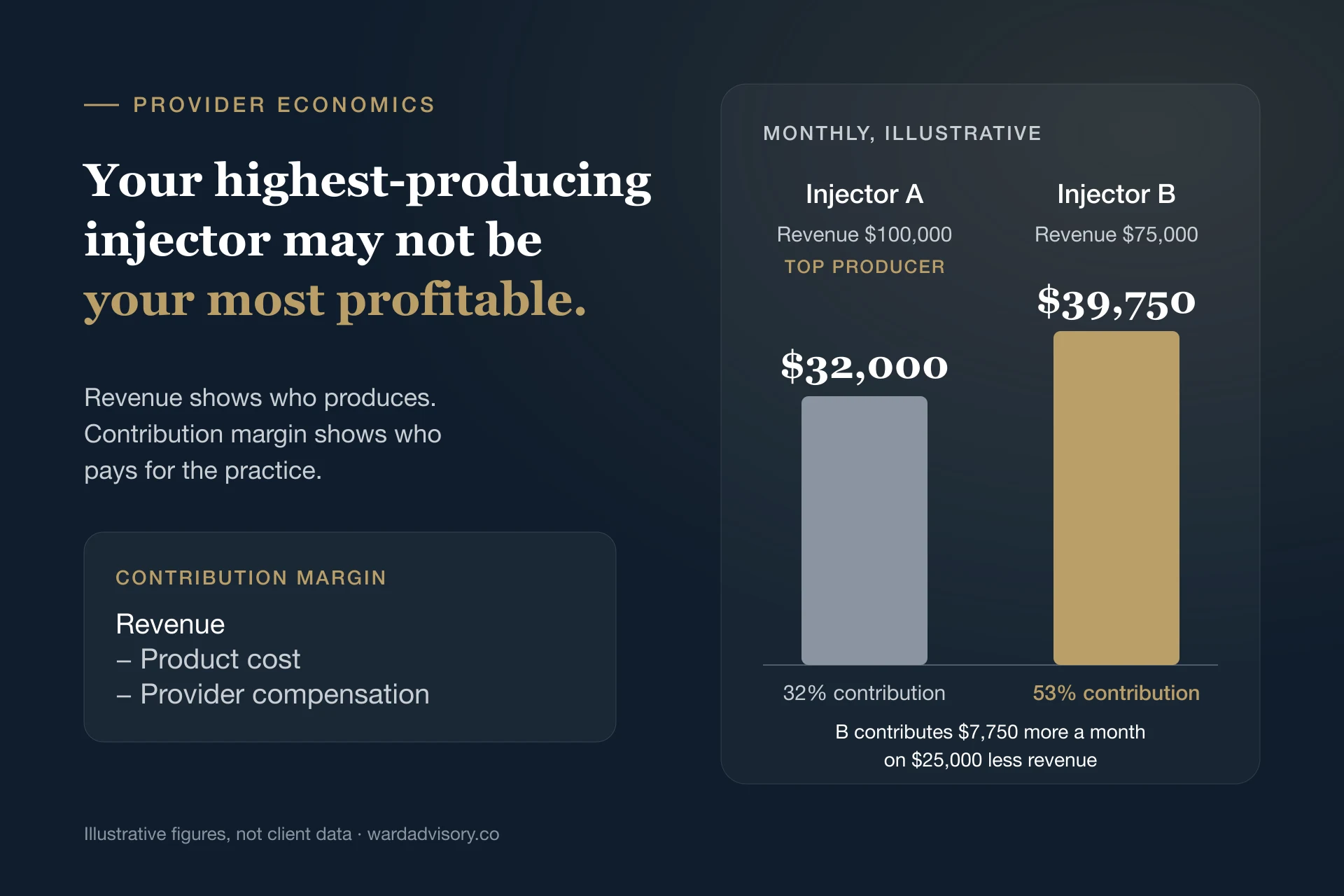
Average ticket makes the revenue report look good. Contribution margin pays the bills. Using average ticket in a break-even calculation pretends every dollar the client spends is available for overhead, and that assumption costs real money every month.
The Real Break-Even Formula
The correct formula is not complicated: break-even appointments equal monthly fixed costs divided by contribution margin per appointment.
Break-even appointments = Monthly fixed costs ÷ Contribution margin per appointment
Example: $25,000 ÷ $150 = 167 appointments per month
Contribution margin per appointment is the ticket price minus every variable cost directly tied to delivering that service: product, disposable supplies, provider commission, and card processing. It does not include rent, front desk salaries, or marketing. Those are fixed costs, and they belong in the numerator.
Now rerun the $40,000 example with the correct input. At a $110 contribution margin, $40,000 divided by $110 is 364 appointments. Not 160.
That is a gap of 204 appointments a month, roughly nine more per clinical day on a 22-day month. If you have been running the practice on 160 as the target, you have been operating at a loss even when the schedule looked full. The number was not slightly off. It was off by more than double, and every pricing, staffing, and marketing decision made on it deserves another look.
| Metric | Owner's Calculation | Actual Calculation |
|---|---|---|
| Fixed Costs | $40,000 | $40,000 |
| Input Used | Average Ticket | Contribution Margin |
| Value Used | $250 | $110 |
| Break-Even Appointments | 160 | 364 |
| Difference | n/a | +204 appointments |
Break-Even Appointment Calculator Table
The table below shows break-even appointment counts across five fixed cost levels and six contribution margin tiers. Find the column closest to your monthly fixed costs and the row that reflects your actual contribution margin per appointment. The intersection is your approximate break-even point.
Average ticket is not in this table. That is intentional.
| Contribution Margin (CM) | $10K/mo | $20K/mo | $30K/mo | $40K/mo | $50K/mo |
|---|---|---|---|---|---|
| $75 | 133 appts | 267 appts | 400 appts | 533 appts | 667 appts |
| $100 | 100 appts | 200 appts | 300 appts | 400 appts | 500 appts |
| $150 | 67 appts | 133 appts | 200 appts | 267 appts | 333 appts |
| $200 | 50 appts | 100 appts | 150 appts | 200 appts | 250 appts |
| $250 | 40 appts | 80 appts | 120 appts | 160 appts | 200 appts |
| $400 | 25 appts | 50 appts | 75 appts | 100 appts | 125 appts |
The table is directional. A practice with a $75 contribution margin and $40,000 in fixed costs needs 533 appointments a month, about 18 a day with no days off. A practice with a $400 contribution margin and $10,000 in fixed costs needs 25. Same industry, very different businesses.
It also shows that contribution margin is the dominant variable. Moving from a $75 to a $150 contribution margin halves the break-even count at every fixed cost level. The fastest way to lower break-even is usually not cutting rent. It is keeping more of every appointment.
Med Spa Cost Structure: Costs and Capacity
Break-even depends on the actual cost structure. Use contribution after variable costs and compare the resulting appointment requirement with deliverable capacity.
Directional planning ranges, not industry standards. Service mix, staffing model, and how costs are classified move every one of these.
Contribution per appointment is collected revenue less product, supplies, variable provider compensation, and payment processing. The contribution needed depends on fixed costs and deliverable appointment volume. Divide fixed costs by contribution per appointment, then compare the required visits with practical capacity.
If provider compensation runs above 35 percent, COGS runs above 20 percent, or contribution margin falls below 40 percent of service price, break-even will be structurally high no matter how full the schedule looks. For margin targets, see our guide on what is a good profit margin for a medical spa.
Why Two Med Spas Can Have Different Break-Even Points
Two practices can charge the same price and have very different break-even points. That is why no universal chart can give you your number. You have to calculate your own inputs.
Illustrative example
Consider two practices side by side. Both charge $250 per appointment and both have $25,000 in monthly fixed costs. Both spend about $7.50 per appointment on supplies and $7.50 on card processing.
Practice A runs a tight operation. Product cost is 18 percent of service revenue ($45), helped by strong vendor terms and disciplined product use. Provider compensation is 25 percent of service revenue ($62.50), structured as a reasonable base plus commission. After product, supplies, provider pay, and card fees, Practice A keeps $127.50 in contribution margin per appointment. At $25,000 in fixed costs, it needs 197 appointments a month to break even.
Practice B has a different structure. Product cost is 32 percent of service revenue ($80), whether from premium products without premium pricing, loose inventory management, or weak vendor contracts. Provider compensation is 40 percent ($100), a commission-heavy structure that looked attractive at hiring and now consumes margin. After the same deductions, Practice B keeps $55 per appointment. At the same fixed costs, it needs 455 appointments a month.
| Metric | Practice A | Practice B |
|---|---|---|
| Average Ticket | $250 | $250 |
| Product Cost % | 18% | 32% |
| Provider Comp % | 25% | 40% |
| Supplies and Card Fees | $15 | $15 |
| Contribution Margin | $127.50 | $55.00 |
| Fixed Costs | $25,000 | $25,000 |
| Break-Even Appointments | 197 | 455 |
Same ticket price, same fixed costs. Practice B needs more than twice the appointment volume to reach the same position. That is a margin structure problem, not a marketing problem, and it explains why one practice feels profitable at 250 appointments a month while another feels broke at 400.
Your med spa profit margin is not determined by your prices. It is determined by what remains after every variable cost walks out the door. Two practices with identical menus and pricing can have contribution margins nearly 30 percentage points apart. The calculation only works with your actual contribution margin, not someone else's average and certainly not your average ticket.
Illustrative Example: Rebuilding One Practice's Break-Even
Illustrative example
Consider an illustrative practice with $36,250 in monthly fixed costs and a $250 average ticket. Dividing one by the other, the owner believes break-even is 145 appointments a month, and assumes the practice is profitable whenever the schedule looks full.
Rebuilt on contribution margin, the picture changes. Provider compensation ($90) and product ($55) together consume 58% of service revenue on the core injectable menu. Add $7.50 of supplies and $7.50 of card fees, and contribution margin is $90 per appointment. True break-even is 403 appointments. With two providers booking eight appointments a day over 22 clinical days, maximum capacity is 352. Break-even sits above what the team can physically deliver.
Now model two changes: a price increase to $275, and a compensation redesign that brings provider pay to 30 percent of price ($82.50). Product stays at $55, supplies at $7.50, and card fees rise to $8.25. Contribution margin becomes $121.75, and break-even falls to 298 appointments, back inside realistic capacity, assuming volume holds after the price change.
The owner in this example did not have a revenue problem. They had a margin problem that average ticket could not show.
The takeaway: If you do not know your contribution margin per appointment, you do not know your break-even point. Many owners discover this only after months of busy-but-broke operations. Rebuild the model on your actual product cost, payroll, and capacity, not on averages.
The 5 Most Common Break-Even Calculation Mistakes
Each of these makes break-even look more achievable than it is, and each delays the moment an owner faces the real math.
-
Using average ticket instead of contribution margin. This is the foundational error. If contribution margin is 40 to 55 percent of the ticket, a break-even built on ticket price understates the true appointment count by roughly half. In the $40,000 example, 160 versus 364.
-
Leaving out owner salary. Many owners do not pay themselves a consistent salary, especially early on. They take draws when cash allows. But the owner's labor is a real cost. If the practice cannot cover a reasonable owner salary, it is not breaking even. It is being subsidized by unpaid owner labor. Add your target owner compensation to fixed costs before running the calculation.
-
Excluding debt payments. Equipment loans, startup lines of credit, and acquisition debt are fixed monthly obligations that do not go away when revenue dips. The bank expects payment whether or not you hit your appointment target.
-
Using annual numbers instead of monthly. Annual break-even hides seasonality. A practice that breaks even for the year might lose money for eight months and make it up in a strong fourth quarter, which means credit lines and cash stress the annual view conceals. Cash flow is monthly, so the calculation should be too.
-
Assuming full utilization. Theoretical and actual capacity differ. A provider working 40 hours a week with 60-minute appointments has 40 slots, but only if there are no no-shows, late arrivals, cancellations, gaps, breaks, charting, or room turnover. Estimate practical capacity from observed appointment durations, cancellations, breaks, charting, and room turnover. Theoretical slots are not a reliable forecast of completed visits.
Capacity Constraints and Provider Utilization
This is the calculation most owners never run, and it shows whether you have a volume problem or a structural problem. The fixes are completely different.
The table below assumes 22 clinical days per month. Use it to find maximum monthly capacity, then compare that to your break-even count.
| Providers | Appointments/Day | Monthly Capacity |
|---|---|---|
| 1 | 8 | 176 |
| 1 | 12 | 264 |
| 2 | 8 | 352 |
| 2 | 12 | 528 |
If your break-even is 320 appointments and one injector can realistically perform 220 a month, marketing is not your problem. You have a margin or capacity constraint that volume cannot fix.
If break-even requires 364 appointments and two providers book eight a day each, maximum capacity is 352. You are 12 appointments short every month before no-shows, gaps, or admin time. Working harder or running another promotion cannot close that.
The Calculation Most Owners Never Run
Maximum monthly capacity is straightforward: providers times available appointment hours per month, divided by average appointment length. Two full-time providers each working 35 clinical hours a week is 70 hours a week, or about 303 hours a month (70 × 52 ÷ 12). At 60-minute appointments, maximum capacity is about 303 appointments a month. Shorter appointments raise it; part-time providers or limited hours lower it.
Compare that with break-even from the correct formula. If break-even requires 364 appointments and capacity is 303, the gap is 61 appointments. Working harder, staying open later, or double-booking cannot close it with current resources.
| Metric | Value |
|---|---|
| Break-Even Appointments Needed | 364 |
| Maximum Monthly Provider Capacity | 303 |
| Gap | -61 appointments |
When Marketing Cannot Fix the Problem
The instinct is to reach for marketing: a promotion, more social ads, a membership discount. But if break-even already exceeds maximum capacity, more appointments are not possible. You cannot market your way past a capacity ceiling.
And more volume at a low contribution margin compounds the problem. Each extra appointment contributing only $55 to $90 adds revenue but does little for fixed costs. You end up busier, more tired, and still losing money. When the schedule is full and cash is still short, look at margin before volume.
The Four Levers That Actually Matter
If break-even exceeds capacity, volume will not save you. Pricing, payroll, product cost, or fixed costs and debt must change. These four levers are what move break-even below the capacity ceiling.
The Four Ways to Lower Break-Even
Three of these increase contribution margin per appointment. One reduces the numerator. None involve running more promotions.
| Lever | Effect | Example |
|---|---|---|
| Raise prices | Increases CM per appointment | $250 to $300 adds about $33.50 to margin at a 30% commission and 3% card fee |
| Reduce COGS | Increases CM per appointment | Renegotiate vendor contracts, switch suppliers, reduce waste |
| Improve payroll structure | Increases CM per appointment | Shift from high-commission to balanced base-plus-commission model |
| Reduce fixed costs | Lowers the numerator | Renegotiate rent, refinance debt, cut non-essential subscriptions |
Raising prices is the most direct lever, but not every dollar of an increase reaches margin. On the $250 appointment above, a $50 increase raises the 30 percent commission by $15 and card fees by $1.50, so about $33.50 reaches contribution margin: $110 becomes $143.50, and break-even at $40,000 in fixed costs falls from 364 to 279 appointments, assuming volume holds. If the provider is paid a flat rate per appointment, about $48.50 flows through, and break-even falls to 253.
Product-cost changes must preserve appropriate clinical care. For illustration, reducing product cost by five percentage points on a $250 service adds $12.50 of contribution per appointment, assuming all other costs stay unchanged.
Payroll structure is the most sensitive lever and the one owners most often avoid. Provider compensation that runs above 35 percent of service revenue makes healthy margins hard to sustain unless prices are well above market. Moving from a straight 40 percent commission to a lower base plus tiered commission can protect income for high performers while improving margin on every appointment.
Fixed cost reduction is the lever owners think of first, and often the hardest to move. Rent is locked into a lease and debt payments are contractual. Still, a $2,000 monthly reduction at a $110 contribution margin lowers break-even by about 18 appointments.
"Run more promotions" is not on this list. More marketing increases volume. It does not change break-even. That distinction separates practices that scale profitably from practices that grow into insolvency. Medical spa financial planning starts with understanding which problems are volume problems and which are structure problems. Marketing solves the first. It cannot solve the second. Our provider economics articles go further into compensation and capacity.
Target Profit Volume vs Break-Even
Breaking even means you did not lose money. You covered costs, paid your providers, and kept the lights on. It does not mean you paid yourself what the work is worth or built capital to hire, expand, or invest. Break-even is the floor, not the destination.
The number that matters is target profit volume: the appointment count that delivers the profit you want. It extends the same formula: target profit volume equals fixed costs plus target profit, divided by contribution margin per appointment.
If fixed costs are $40,000 a month and you want $20,000 of monthly profit, for owner return above a reasonable salary, reinvestment, or reserves, the math is $40,000 plus $20,000, or $60,000. Divided by a $150 contribution margin, that is 400 appointments a month.
Break-even at that contribution margin is 267 appointments. Target profit volume is 400, which is 133 more appointments every month. That is the number that funds growth and pays you for the risk you took.
A calculator that only shows break-even is showing you the minimum. Decisions about hiring, marketing spend, capacity, and owner distributions should be made against target profit volume. Break-even tells you the floor. Target profit volume tells you the goal.
Frequently Asked Questions
How many appointments does a med spa need to break even?
Divide your monthly fixed costs by your contribution margin per appointment, not your average ticket. A practice with $25,000 in fixed costs and $150 contribution margin needs about 167 appointments per month. Because contribution margin is often only 40 to 55 percent of the ticket, using average ticket instead understates break-even by roughly half.
What is a good contribution margin for a med spa?
Contribution per appointment is collected revenue less product, supplies, variable provider compensation, and payment processing. The contribution needed depends on fixed costs and deliverable appointment volume. Divide fixed costs by contribution per appointment, then compare the required visits with practical capacity.
What percentage should provider compensation be?
Assess provider compensation against that provider's service revenue and the contribution left after other delivery costs. A universal compensation percentage cannot establish whether the service is sustainable.
What if my break-even exceeds provider capacity?
You have a structural margin problem, not a marketing problem. More ads cannot close a gap when your team cannot physically deliver enough appointments. Fix pricing, COGS, payroll structure, or fixed costs until break-even falls below your realistic monthly capacity.
How often should I recalculate break-even?
Recalculate monthly. Fixed costs, product costs, compensation, and service mix change throughout the year. Annual averages hide months where you are underwater and create cash flow surprises.
Is break-even the same as profitability?
No. Break-even only means you covered costs. Profitability requires target profit volume: enough appointments to pay yourself, service debt, reinvest, and build reserves. Set a target profit in dollars and plan volume to reach it, not break-even alone.
Your Next Step: Calculate Your Real Numbers
Start with the service you perform most often. Use the Ward Advisory Contribution Margin Calculator to work out your actual contribution margin per appointment from product cost, supplies, client price, and provider commission. That number is the foundation of your break-even model.
Run the formula in the Quick Answer box against your fixed costs, including owner salary and debt payments. Compare the result with your capacity. If break-even exceeds capacity, work the four levers in order: pricing, product cost, payroll structure, then fixed costs.
Break-even is one number inside a larger system. Once you know it, it belongs on the KPI dashboard layer of a med spa financial operating system, tracked alongside contribution margin and payroll percentage rather than calculated once and forgotten.
You probably don't know your number.
Most med spa owners can tell you revenue. Very few can tell you contribution margin per appointment, which means they do not actually know their break-even point. Ward Advisory can help work out what yours is and what is driving it.
Request a Strategy CallAbout the author
Tanner Ward
Tanner Ward is a fractional CFO specializing in medical spas and founder of Ward Advisory. He helps aesthetic practices improve cash flow, increase profitability, and build financial systems that support sustainable growth.