Why Your Med Spa Feels Busy But Your Bank Account Is Empty
Your schedule is full but the bank account is empty. The 4 structural reasons a med spa is busy but not profitable, and how to fix each one.
What this helps diagnose:The schedule is full and the bank account still feels tight.

The Friday before payroll, you stare at your bank balance and feel a familiar knot in your stomach. The schedule was packed all month. The revenue report looks strong. Patients were in and out of every treatment room from morning until close. And yet the number on the screen doesn't lie: there isn't enough to cover payroll, the laser lease, and the product order that's already three days late. You're not alone in this. A med spa that is busy but not profitable is one of the most common and least discussed problems in aesthetic medicine.
The deferred revenue trap explains part of it. We covered that in our cash flow versus revenue article. But deferred revenue alone does not explain why your bank account is empty every month. Here are the four structural causes that article did not cover.
Many med spas are not unprofitable because they are under-booked. They are unprofitable because operational complexity expanded faster than financial discipline. All four causes below are the kind of structural blind spot a monthly close-and-decide rhythm is designed to catch. See a full med spa financial operating system for how that rhythm works, and the profitability topic hub for the related articles.
Table of Contents
- The Four Structural Causes of the "Busy But Broke" Med Spa
- The Busy-but-Broke Spiral
- Root Cause #1: Your Services Are Underpriced and You Don't Know It
- Root Cause #2: Payroll Crept Up During a Good Month and Never Came Back Down
- Root Cause #3: No Owner Salary Structure, Making True Profit Invisible
- Root Cause #4: Fixed Debt Payments That Don't Flex With Revenue
- The Gut Punch: When Two or Three Causes Hit Simultaneously
- What Healthy Med Spa Economics Usually Look Like
- Why More Marketing Won't Fix a Leaky Revenue System
- Busy-but-Broke Self-Diagnostic: 5 Questions
- Diagnose First, Then Implement
- The Bottom Line: Busy Is Not Profitable, But Profitable Can Be Busy
The Four Structural Causes of the "Busy But Broke" Med Spa
What separates a genuinely profitable med spa from one that merely looks busy isn't a single bad month or an unlucky stretch. It's a set of design flaws built into the operating model itself. These aren't mistakes you made last quarter. They're structural decisions, often made years ago, that have quietly compounded into a system where activity and profit have decoupled. Each of the four causes below is independently damaging. When two or three hit at once, the result is the scenario you may be living: full books, empty accounts, and a growing sense that you're working harder than ever for less. Every section that follows ends with a specific fix. Eventually the bank account exposes the structural flaws, whether the owner sees them early or late.
The Busy-but-Broke Spiral
This pattern is common, and it is not random. It follows a predictable sequence:
| Stage | Operational Decision | Financial Consequence |
|---|---|---|
| Revenue spikes | Owner hires ahead of cash flow | Fixed payroll rises |
| Cash feels strong | Promotions expand | Deferred liabilities rise |
| Volume slows | Revenue normalizes | Margin compresses |
| Fixed costs remain | Cash reserves shrink | Owner delays pay |
| Stress increases | More marketing launched | Burnout accelerates |
The spiral only stops when you interrupt it with a structural fix: not another promotion, not another hire, and not another month of hoping volume saves you.
Root Cause #1: Your Services Are Underpriced and You Don't Know It
Most med spa owners price services by looking sideways at competitors instead of downward at their own cost structure. The neurotoxin place down the street charges $12 per unit, so you charge $11. The med spa across town runs a 20%-off membership, so you build one too. This is competitor-based pricing, and it's the fastest way to guarantee you'll never know whether any given treatment actually makes money. The alternative, which few owners adopt until they're forced to, is cost-based pricing built on contribution margin math.
The Contribution Margin Math Most Owners Skip
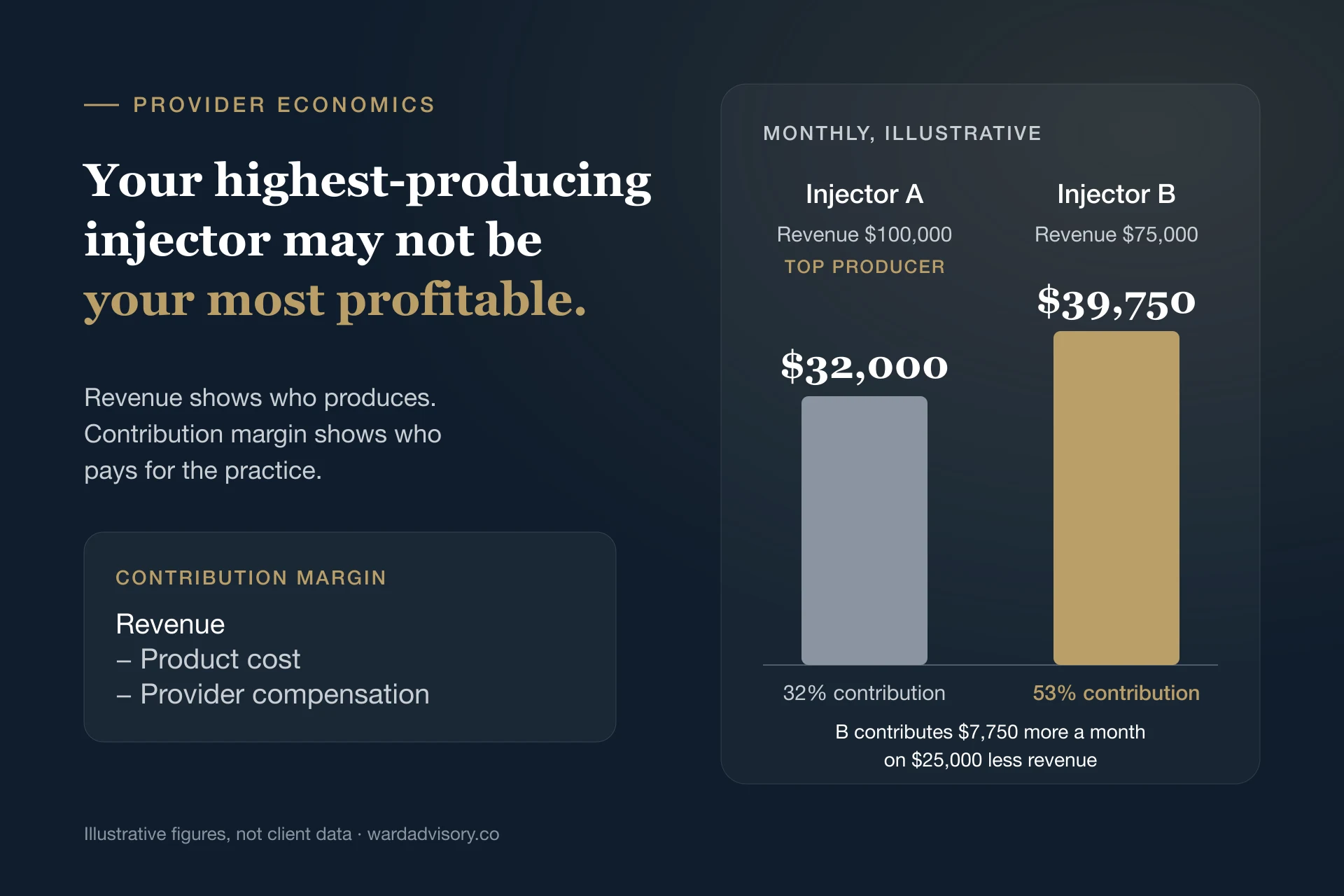
Contribution margin is the amount of revenue from a single service that remains after you subtract every direct cost of delivering that service. Direct costs include product, supplies, injector commission or labor, disposable items, and room preparation time. They don't include overhead: rent, front desk payroll, marketing, software subscriptions, and your own salary. Contribution margin answers a single question: does this service generate enough cash to contribute to overhead and profit, or does it consume cash every time you perform it?
Here's the math most owners never run.
Illustrative example
Take a 40-unit neurotoxin treatment priced at $600 ($15 per unit). At an assumed product cost of $6 per unit, product runs $240. Injector commission at 35 percent of the $600 treatment is $210. Supplies, disposables, and room prep add another $15. That's $465 in direct costs against $600 in revenue, leaving a contribution margin of $135, or 22.5 percent.
| Cost Item | Amount |
|---|---|
| Treatment Revenue | $600 |
| Product Cost (40 units × $6) | ($240) |
| Injector Commission (35% of revenue) | ($210) |
| Supplies & Disposables | ($15) |
| Stated Contribution Margin | $135 |
| Contribution Margin % | 22.5% |
On paper, the treatment still contributes something. Now add the factors that don't appear on any invoice: loyalty program redemptions that effectively discount the treatment, no-shows where product was already drawn, and complimentary touch-ups that consume product and injector time without generating revenue. Over-portioning, dilution inconsistency, and expired product add to it. Put together, that leakage can easily take a treatment the owner thought was profitable down to one that contributes less than $100 to overhead. Some services, when you run the full allocation, have a negative contribution margin. Every time you book them, you lose money.
This table is where most owners stop. Waste, touch-ups, no-shows, and loyalty redemptions are not in it, and that's exactly why the number is wrong.
The Hidden Costs That Destroy Margin
Waste is the silent margin killer in aesthetic medicine. Neurotoxin over-portioning, where injectors use more units than they document to reach a result they're comfortable with, adds up quickly: two undocumented units on a 40-unit treatment is 5 percent more product than you charged for. Filler expires because inventory wasn't rotated. Single-use disposables get opened for a treatment that cancels at the last minute. These costs are invisible on a standard profit-and-loss statement because they're buried in aggregate cost of goods sold. You see total product expense as a percentage of total revenue, and it might look acceptable. But that aggregate number hides the treatment-level reality, where some services are margin-negative and others carry the entire practice. For the per-unit economics most practices never calculate, see our Botox profitability breakdown.
The Fix: Service-Level Profitability Audit
Run a contribution margin analysis for every service line on your menu. Pull 12 months of treatment data, calculate actual product cost per treatment including a waste estimate, add injector compensation at the per-treatment level, and allocate disposables and room time. Sort the results from highest contribution margin to lowest, and you'll find a cluster of services at the bottom that are barely positive or outright negative. Those are your candidates for price increases, bundling changes, or elimination.
Then set a floor. A single percentage floor for every service doesn't work, because injectables carry heavy product cost and device treatments don't. A better floor is dollars of contribution per treatment-room hour: take your monthly overhead, divide it by the room hours you actually have available, and require every service to clear that number plus a profit margin. If a treatment can't clear it after all direct costs, the price is wrong, the cost structure is broken, or the service doesn't belong on your menu. Run the analysis quarterly, because product costs, injector efficiency, and your service mix all shift over time.
Root Cause #2: Payroll Crept Up During a Good Month and Never Came Back Down
There's a predictable sequence in med spas. Revenue spikes in March or October, the schedule is overflowing, and the owner makes a series of reasonable-seeming decisions. She adds a part-time front desk person to handle call volume. She increases the hours of the medical assistant who's been asking for more shifts. She approves a raise for a key injector who had another offer. Each decision makes sense in isolation. The problem is what happens next month, when revenue drops back to normal and those costs remain.
The Permanent Fixed Cost Increase Trap
Payroll decisions made during revenue peaks become permanent fixed costs, while revenue stays variable. Adding one front desk person at $22 per hour for 40 hours a week adds about $45,760 a year (2,080 hours), or roughly $3,800 a month, before payroll taxes and benefits. That cost has to be covered whether the schedule is full or empty. During the good month, the math worked: the extra revenue covered the extra cost with room to spare. But when the seasonal slowdown hits, or a key injector leaves and patient visits dip for two quarters, that front desk wage doesn't disappear. It becomes part of the baseline cost structure, and the owner finds herself covering payroll out of cash reserves or, worse, personal savings.
The same dynamic applies to injector compensation built on a high guaranteed base instead of a production-based model. If you guarantee an injector a $90,000 base and their production only supports about $70,000 of pay under your target compensation ratio, the practice absorbs a $20,000 shortfall. That shortfall comes directly out of profit, and in many practices, directly out of the owner's take-home pay.
Why Payroll Percentage Benchmarks Don't Tell the Full Story
The payroll analysis separates compensation, employer taxes, benefits, and revenue bases. Evaluate the fixed component that does not flex with demand, then assess how much contribution remains to fund it.
Take a practice running 40 percent payroll where 30 of those 40 points are salaries and scheduled hourly wages, and 10 are commissions and bonuses. When revenue drops 10 percent, only the variable 10 points move with it. Payroll dollars fall about 2.5 percent, and payroll as a share of revenue climbs from 40 percent to about 43 percent. This is why practices that look well-managed on an annual basis can still run out of cash in February.
The solution isn't to underpay staff or avoid hiring. It's to build a compensation structure where a meaningful portion of total payroll moves with revenue. Our injector compensation article covers how to structure provider pay so practice margins hold up in both high-volume and low-volume months.
The Fix: Variable Compensation Structure
Model fixed and variable payroll separately. Stress-test the fixed portion under a plausible revenue downturn, and evaluate any change in compensation for service quality, retention, and legal requirements.
Front desk and support roles can carry a base wage plus a variable component tied to daily revenue, booking volume, or rebooking rate. When the schedule is full and revenue is strong, the team earns more. When things slow down, payroll contracts on its own. That protects the practice during downturns and aligns staff incentives with practice performance. For injectors, tie compensation to contribution, not gross revenue. An injector generating high revenue on low-margin services isn't contributing as much as one generating moderate revenue on high-margin services, and the pay plan should reflect that. Finally, set a payroll reset trigger: if monthly revenue drops 10 percent below the trailing six-month average, total payroll hours come down proportionally within 30 days. This isn't a layoff policy. It's a pre-planned reduction in overtime, part-time hours, and discretionary shifts that the team understands in advance.
Root Cause #3: No Owner Salary Structure, Making True Profit Invisible
Of the four structural causes, this one is the most personal and the most often ignored. The owner of a med spa typically pays herself last, from whatever cash remains after everyone else has been paid. Product suppliers get paid. The landlord gets paid. Injectors get their commissions. The front desk team gets their hourly wages. The laser lease payment clears. And then, if there's anything left, the owner transfers some amount to her personal account, often with a pang of guilt or anxiety. This arrangement means the owner's labor is unpriced. The business reports a profit on paper, and the owner looks at that number and wonders why she can't pay her mortgage.
The Owner-as-Unpaid-Labor Problem
When you don't pay yourself a structured salary, you're making a silent contribution to the business every month in the form of unpaid labor. That contribution doesn't appear on the profit-and-loss statement as an expense, so the P&L overstates the true profitability of the practice. The business looks healthy. The owner is anything but. This is one of the most common reasons a med spa that looks profitable on paper has an empty bank account. Part of the reported profit isn't profit. It's the owner's salary, recorded as earnings, and it's often less than the owner would make working as an injector for someone else.
Consider the math. A $1.5M practice showing a 20 percent net profit margin reports $300,000 in profit. The owner works 50 hours a week as both clinical director and CEO. Suppose it would cost $150,000 a year to hire people to do that clinical and management work. That figure is a replacement-cost planning assumption, not a market survey; your number depends on your market and exactly which roles you cover. On that assumption, the practice's true profit is not $300,000. It's $150,000, a 10 percent margin. The other $150,000 is the owner's unpaid wages. And if the owner is also seeing patients, the distortion is worse, because her clinical production masks how the business would perform without her free labor.
What "Profit" Actually Means When You Don't Pay Yourself
True profit equals revenue minus all expenses, including a market-rate salary for the work the owner does. If you're not paying yourself, you're not calculating profit. You're calculating a number that mixes return on labor with return on capital, and the two are different. Return on labor is what you earn for showing up and working. Return on capital is what the business earns after paying everyone, including you, for their labor. A practice that can't generate a return on capital after paying the owner a market-rate salary is not yet a profitable business. It's a job, and often a poorly paid one relative to the hours, stress, and financial risk involved.
This distinction changes every decision you make. When you believe your practice earns 20 percent net profit, you might feel comfortable adding a new laser lease or hiring another injector. When you correctly calculate that it earns 10 percent after your own salary, those same decisions look very different. The empty bank account on Friday is telling you something: your labor isn't free, and pretending it is doesn't make the business more profitable. It just makes you the last person to get paid.
The Fix: Set an Owner Salary First
Estimate what it would cost to replace the work you do. If you're the clinical director, medical director, and CEO, price each function separately at local market rates. Pay yourself that amount as a fixed expense every month, the same way you pay rent, and count it before you calculate profit. If the business cannot support that salary consistently, the practice isn't yet profitable on its own; it depends on your unpaid work. That isn't a judgment. It's a diagnosis. Once your salary is a fixed line item, the true profitability of the practice shows up in the numbers, and you can make decisions based on reality instead of an accounting fiction.
Root Cause #4: Fixed Debt Payments That Don't Flex With Revenue
This section is not an argument against debt. Debt is a tool, and used properly, it finances the equipment and build-out that make a med spa competitive. The problem isn't borrowing. It's the mismatch between fixed payment schedules and variable revenue, which creates cash flow rigidity that can break a practice during slow months.
Cash Flow Rigidity vs. "Debt Is Bad"
Laser leases, equipment financing, and build-out loans share one feature: the payment is due on the first of the month regardless of what happened to revenue last month. A slow January doesn't mean the bank takes a holiday. The payment clears, and if the cash isn't there, overdraft protection kicks in, the owner transfers personal funds, or a vendor payment gets delayed. This is cash flow rigidity. The practice has committed to fixed outflows that don't adjust when inflows decline, and the gap is absorbed by the owner's cash reserves, personal credit, or the practice's ability to pay other bills on time.
The Math of Fixed Obligations Against Variable Revenue
Imagine a practice with $15,000 a month in combined debt payments: an $8,000 laser lease, a $4,000 equipment financing payment, and a $3,000 build-out loan payment. The practice averages $180,000 a month in revenue, so the debt load looks manageable at about 8 percent of revenue. But the practice has seasonal swings. In the first quarter, monthly revenue drops to $130,000. That $50,000 revenue swing doesn't reduce the $15,000 debt payment by a single dollar. The payment still comes out, but now it's 11.5 percent of a much smaller revenue base. Meanwhile payroll, with its large fixed component, doesn't flex proportionally either. Rent doesn't flex. Software subscriptions don't flex. The owner faces a month where fixed obligations consume a much larger share of revenue, and the only places to absorb the difference are her take-home pay and the practice's cash reserves.
The compounding effect is what makes this dangerous. When fixed debt payments, fixed payroll, and fixed occupancy costs all hit during a low-revenue month, the practice can burn through months of accumulated cash in a few weeks. The owner who thought she had a profitable year suddenly can't make payroll without a personal loan.
The Fix: Match Debt Structure to Revenue Patterns
Negotiate payment schedules that match your practice's seasonal revenue pattern. If your slowest months are January through March, ask your lenders about seasonal payment structures that lower required payments in those months and raise them in peak months. For equipment, ask about usage-based structures instead of flat monthly payments. Some device financing arrangements set a lower monthly minimum and trigger additional payments only when utilization passes a threshold, which shifts some revenue risk to the lessor financing a revenue-generating asset. Finally, build a cash reserve equal to three months of fixed debt obligations before taking on new financing. That reserve is the buffer that keeps a slow quarter from becoming a liquidity crisis.
The Gut Punch: When Two or Three Causes Hit Simultaneously
The four structural causes above are dangerous in isolation. In practice, they rarely appear alone. Most med spas that feel busy but have empty bank accounts are dealing with at least two of them, and many are dealing with all four. The compounding effect is what turns a manageable problem into a crisis the owner feels physically every time she opens the banking app.
A Real-Number Example the Owner Will Recognize
One caution before the numbers. It's tempting to add up every leak and subtract the total from reported profit. That double-counts. Underpricing and payroll creep have already happened, so they're already inside the reported profit figure. The only adjustment reported profit needs is the one the P&L leaves out: a salary for the owner's work.
Illustrative example
Consider a $2M practice with a full schedule, a strong reputation, and an owner who hasn't taken a real vacation in three years. It reports $200,000 of net profit, a 10 percent margin. All four causes are active:
- Underpricing and leakage: 8 percent margin erosion on $1.2M of treatment revenue, from competitor-based pricing, product waste, and loyalty program dilution. That's $96,000 a year of contribution margin that never arrived.
- Payroll creep: $4,000 a month of excess fixed labor from staff added during a strong quarter and never reduced. That's $48,000 a year.
- No owner salary: the owner works full-time as clinical director and CEO. Replacing that work would cost about $120,000 a year (a replacement-cost planning assumption). She takes sporadic owner draws averaging about $40,000 a year. Draws are distributions, so none of her pay is on the P&L.
- Rigid debt: $18,000 a month ($216,000 a year) of laser lease, equipment financing, and build-out loan payments that don't flex with seasonal swings.
Step 1: What the practice actually earns.
| Reported Net Profit (no owner salary on the P&L) | $200,000 |
| Less: Replacement cost of the owner's clinical and management work | ($120,000) |
| Adjusted Profit | $80,000 (4.0% of revenue) |
Step 2: Where the missing profit went. The first two leaks explain why reported profit is only $200,000. They are not subtracted again.
| Annual | |
|---|---|
| Underpricing and leakage (8% of $1.2M) | $96,000 |
| Payroll creep ($4,000 a month) | $48,000 |
| Profit already lost to the two leaks | $144,000 |
| Reported profit if both were fixed | $344,000 |
| Adjusted profit if both were fixed | $224,000 (11.2% of revenue) |
Step 3: Why the bank account goes negative anyway. Loan and finance-lease principal is a cash payment that never appears on the P&L. Suppose $150,000 of the $216,000 in annual debt payments is principal. Ignoring depreciation and working capital for simplicity, $200,000 of reported profit leaves $50,000 of cash after principal. The owner's $40,000 of draws leaves about $10,000 of cushion for the entire year. One slow quarter wipes that out.
The owner takes home $40,000 for 50-hour weeks, which works out to about $15 an hour. The schedule is full. The revenue looks strong. And the owner is slowly going broke. Fixing the two leaks would not just make the P&L look better; it would put roughly $144,000 a year of cash back into a business that currently has almost none to spare.
Why This Pattern Keeps Repeating
The same combination shows up at very different revenue levels. The revenue number changes; the structural flaws don't. Growth hides the problem for a while, because more patients mean more cash in the door, which covers the leaks for another quarter. But when volume normalizes, the same four causes resurface. The busy-but-broke owner isn't failing because she's bad at aesthetics. Her practice was designed to convert activity into more activity, not into cash.
The Fix: A Single Diagnostic Tool
Run a cash flow stress test using your actual numbers from the last 12 months. Take each month's revenue and subtract actual fixed obligations: debt payments, fixed payroll, rent, and a market-rate owner salary. Find the months where the remaining cash is negative, and trace the shortfall back to one of the four causes. Which cause is the primary driver in your practice? Is it margin erosion on your highest-volume services? Payroll that never reset after a good quarter? The fact that you haven't paid yourself in six months and the business can't actually afford you? Debt payments that consume 30 percent of revenue in slow months? Fix the biggest leak first. Don't try to solve all four at once. One structural repair, executed completely, will do more for your bank account than four half-fixes that never get finished.
What Healthy Med Spa Economics Usually Look Like
A financially resilient practice can explain how service contribution covers payroll, overhead, debt payments, and owner labor. Review these questions against your own forecast:
| Area | Diagnostic question |
|---|---|
| Payroll | What is fixed, and does service contribution fund it in a slow month? |
| Cash | Can the forecast cover bills and prepaid treatment obligations? |
| Owner pay | Is owner labor included before calculating profit? |
| Pricing | Does each service contribute enough after delivery costs? |
| Debt | Can the business service debt through a plausible downturn? |
Use actual records to investigate a shortfall. No single percentage establishes whether a practice is solvent.
Why More Marketing Won't Fix a Leaky Revenue System
When the bank account is empty and the schedule is full, the instinct is to fill the schedule even more. More Instagram ads. Another promotional event. A new patient acquisition campaign. That's pouring more water into a bucket with four holes in the bottom. Adding patients to a system that leaks margin on every treatment, carries excess fixed payroll, doesn't price owner labor, and is saddled with rigid debt payments doesn't solve the problem. It accelerates the cash burn. More patients means more product consumed at thin or negative margins, more staff hours to support the volume, and more pressure on a cash flow structure that was already breaking. The advantage belongs to the operator with the cleanest revenue system, not the biggest marketing budget. Fix the leaks first. Then scale what works.
Busy-but-Broke Self-Diagnostic: 5 Questions
Before you commit to another marketing push, answer these five questions with real numbers from your last 12 months:
- Contribution margin: Can you state the margin on your top three services after product, commission, supplies, and estimated waste?
- Payroll structure: Can service contribution cover fixed payroll in a plausible slow month?
- Owner compensation: Are you on a structured monthly owner salary, or drawing sporadically from whatever is left?
- Debt rigidity: Do fixed debt payments clear every month even when revenue drops 25% or more in a slow quarter?
- True profit: If you subtracted a market-rate salary for your own work from reported profit, would adjusted profit still be positive?
Scoring: If you answered "no" or "I don't know" to two or more, your practice likely matches the busy-but-broke pattern this article describes. The next step is not more volume.
Where to go next:
- Run your numbers with the Botox profit margin calculator to see treatment-level economics in minutes.
- Estimate your profitability gap to see how far your margin sits from where it could be.
- Browse the profitability articles for the pricing, margin, and cash flow pieces that go deeper on each cause.
Diagnose First, Then Implement
Diagnosing the four structural causes takes more than reading an article and nodding along. It means running your actual numbers through the frameworks above and producing a ranked list of problems by financial impact. Once the primary constraint is identified, the work of rebuilding the practice's financial structure begins.
Step One: Build the Four Reports
You can do this yourself with a year of data and a spreadsheet. You need four things:
- A service-level contribution margin report that ranks every treatment on your menu by true profitability after all direct costs and a waste allowance.
- A payroll structure analysis that separates fixed from variable pay and shows how much fixed payroll was added in strong months and never reversed.
- An owner compensation calculation that estimates the replacement cost of each role you perform and compares it with what you actually take home.
- A debt stress test that lays your fixed obligations against your lowest-revenue months and shows where cash breaks.
Step Two: Fix One Constraint at a Time
The reports will almost always point to one cause that matters more than the others. Start there. Rebuilding pricing, restructuring compensation, formalizing owner salary, and renegotiating debt are each real projects with their own sequencing, and trying all four in the same quarter usually means none of them finishes. If you want an outside view on which constraint to take first, how we help explains how Ward Advisory approaches that diagnosis.
The Bottom Line: Busy Is Not Profitable, But Profitable Can Be Busy
Busy measures activity. Profitable measures results. The two are not the same, and confusing them is one of the most expensive mistakes a med spa owner can make. The four structural causes described here are not character flaws or signs of business incompetence. They're design problems, and design problems have design solutions. If you recognized your practice somewhere in this article, the issue is structural, not personal. The first step is not working harder, marketing more, or hoping next month is better. It is running the numbers that tell the truth.
| The Problem | What Most Owners Do | What Actually Fixes It |
|---|---|---|
| Tight cash flow | Run more promotions | Service-level margin analysis |
| Payroll pressure | Work longer hours | Variable compensation structure |
| No owner pay | Delay distributions | Structured salary as fixed expense |
| Revenue swings | Launch new marketing | Debt restructuring + cash reserve |
Start with the 5-question self-diagnostic above. The bank account won't fix itself, but it will respond to a practice rebuilt to convert busy into profitable.
See this problem in your practice?
Ward Advisory can help work out how large the financial impact actually is and what's driving it.
Request a Strategy CallAbout the author
Tanner Ward
Founder of Ward Advisory. Tanner works with established med spas and aesthetic practices on where profit and cash are being lost and what to change, drawing on 10+ years of finance and operating experience.