Memberships vs. Packages: Which Model Actually Creates More Profit for Med Spas?
Med spa membership vs package pricing: discover which model actually creates more profit. A financial diagnostic that goes beyond revenue to reveal the bottom line.
What this helps diagnose:Your membership is growing, and you are not sure it is making money.
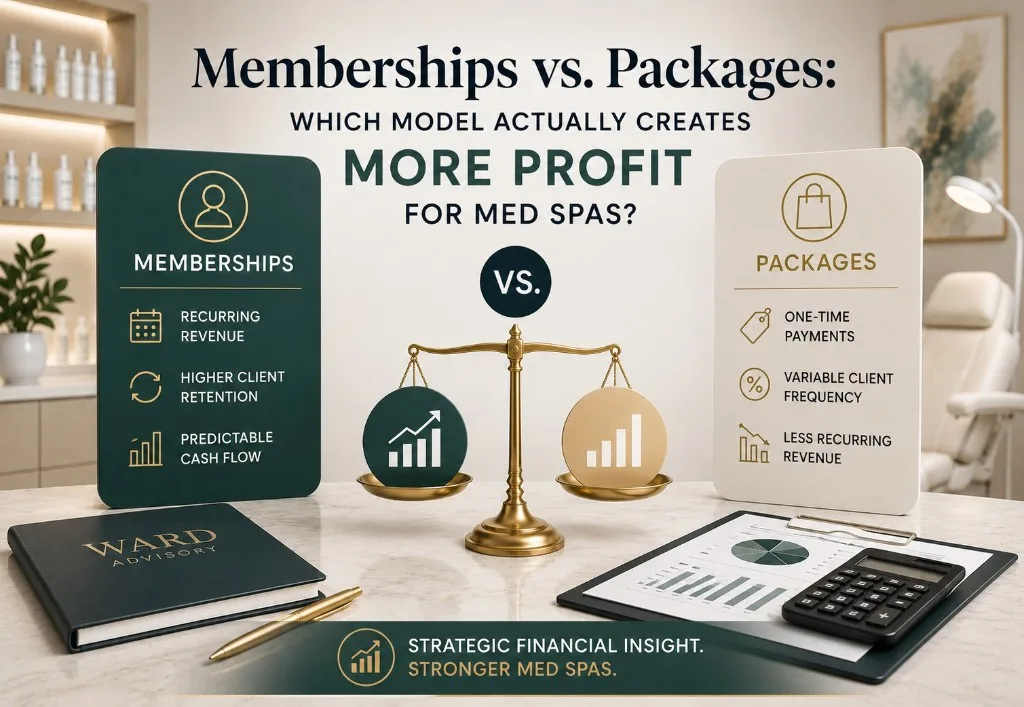
The dashboard tells a compelling story. Three hundred active members. Thirty-seven thousand dollars in monthly recurring revenue. A membership base that has grown forty percent year over year. The owner looks at these numbers and sees validation: the membership program is working.
Table of Contents
But there is a question this owner has never actually answered.
Is the membership program producing more profit than the package model it replaced?
This is not a question most med spa owners ask. They measure membership success the way software companies do: active members, signups, recurring revenue. The dashboard lights up green, and the assumption hardens into certainty. Recurring revenue is the future. Membership count is the scoreboard.
What if that assumption is wrong?
What if the membership program is increasing revenue while reducing profit?
Some med spas spend years growing membership programs that never actually improve owner income.
What if the predictable monthly cash flow is masking contribution margins too thin to sustain the business through a slow quarter?
When evaluating med spa membership vs package pricing, most owners stop at top-line revenue. This article stops at the bottom line. It is not a recommendation piece. It is a financial diagnostic. It will not tell you which model to choose. It will give you the framework to determine which model actually creates more profit in your specific business, with your specific numbers, your specific cost structure, and your specific clients.
The goal is not maximizing membership signups. The goal is maximizing lifetime contribution margin per client. Everything that follows serves that single metric.
Why This Decision Matters More Than Most Owners Realize
The choice between a membership model and a package model is not a marketing decision. It is a structural financial decision that determines how revenue flows into the business, how costs attach to that revenue, and how much profit remains after both settle. Most owners treat it as a growth lever. It is actually a margin lever.
Rising customer acquisition costs make this decision more consequential than it was 5 years ago. Paid advertising costs have climbed across every channel. The cost to acquire a new med spa client now routinely exceeds $200 in competitive markets, and that figure does not include the time spent on consultation, follow-up, and conversion. When acquisition costs rise, every client relationship must generate higher lifetime value to justify the upfront investment. A model that shortens client lifespan, even unintentionally, becomes a compounding liability.

Staffing constraints add another layer of pressure. Qualified injectors and laser technicians are scarce. Their time is the binding constraint on revenue. If a membership program encourages utilization that consumes provider time without generating sufficient contribution margin, the business is effectively selling its most limited resource at a discount. Capacity is not infinite. Every treatment slot filled by a low-margin member visit is a slot unavailable for a higher-margin service.
Product costs and provider compensation continue to rise. Neurotoxin costs per unit, dermal filler costs per syringe, and competitive provider pay rates all compress the spread between what a treatment costs to deliver and what the client pays. A pricing model that worked when Botox cost $6 per unit may fail when it costs $8 or $9. The model must protect contribution margin, not just generate cash flow. For treatment-level margin math, our Botox profitability breakdown walks through the per-unit economics most practices never calculate.
Revenue predictability has real value. A business with $30,000 in recurring monthly revenue can plan staffing, inventory, and capital expenditures with more confidence than a business reliant on episodic package sales. But predictable losses are still losses. A membership program that generates predictable negative contribution margin is not an asset. It is a structured drain. We covered this dynamic in our cash flow versus revenue article.
The core objective is not enrollment volume. It is not recurring revenue growth. It is not membership count. The core objective is maximizing lifetime contribution margin per client. Every decision about pricing, benefits, discounting, and retention should be evaluated against that single standard.
How Package Models Actually Work
The Upfront Economics of Packages
A treatment package is straightforward in structure. The client pays a lump sum for a predetermined set of treatments: 3 sessions of Botox, 6 sessions of laser hair removal, 3 sessions of Morpheus8. The cash arrives upfront. The revenue is recognized over time as each treatment is delivered, sitting on the balance sheet as deferred revenue until fulfillment occurs.
The financial appeal is immediate. Strong upfront cash flow funds operations, marketing, and growth without waiting for recurring billing cycles to accumulate. The client commits to multiple treatments at the point of sale, which creates a sunk cost effect: having already paid, the client is more likely to complete the series. Completion drives results. Results drive satisfaction. Satisfaction should drive repurchase.
The package model also simplifies pricing psychology. A 3-session Botox package priced at $1,500 feels like a better value than $500 per session, even when the per-session price is identical. The bundle itself communicates value, and the commitment locks the client into a treatment cadence that builds habit formation.
The Hidden Risks: Revenue Cliffs and Retention Gaps
The package model contains a structural weakness that most owners underestimate: the revenue cliff.

When a client completes a package, the financial relationship ends. There is no automatic billing cycle. No recurring charge. No built-in reason for the client to return. The business must actively re-engage that client, overcome inertia, and sell a new package or treatment. Every package completion represents a retention event that the business can lose.
Repurchase rates are often lower than owners assume. A client who buys a 6-session laser hair removal package may complete the series over 8 months and then disappear. The goal of laser hair removal is permanent reduction. Once achieved, the client has no ongoing treatment need. The package fulfilled its clinical purpose and simultaneously ended the commercial relationship.
High-ticket packages amplify this risk. A Morpheus8 package at $3,000 represents a significant financial commitment. The decision cycle to repurchase is long. The treatment itself is intense. The results are gradual. The client may be satisfied with the outcome and still not repurchase for 12 to 18 months, if ever. The revenue cliff after a high-ticket package is steeper and the repurchase timeline is longer.
Realistic Package Examples
Illustrative only: The package ranges below reflect typical US med spa markets for financial modeling. They are not Ward Advisory pricing recommendations. Actual pricing varies by geography, provider experience, brand positioning, and local competition.
The following examples use pricing ranges that reflect typical US med spa markets. Actual pricing varies significantly by geography, provider experience, brand positioning, and local competitive dynamics. These figures demonstrate financial concepts only.
Botox Package (3 treatments): $1,350 to $1,800. The repurchase potential is relatively high if the client has established a neuromodulator habit. Tox requires maintenance every 3 to 4 months, creating a natural repurchase cycle. The package serves as an introduction to a recurring treatment pattern.
Laser Hair Removal Package (6 treatments): $900 to $2,500. The repurchase rate is lower by design. The treatment goal is completion and permanent reduction. Additional areas may be purchased, but the original treatment area should not require ongoing packages. The revenue stream is finite.
HydraFacial Package (3 treatments): $600 to $900. Repurchase is moderate and often seasonal. Clients may buy a package before wedding season or summer and then lapse. The treatment is elective and lifestyle-driven rather than medically necessary, creating less consistent repurchase behavior.
Morpheus8 Package (3 treatments): $2,000 to $3,500. This represents the lowest repurchase rate among common package types. The ticket is high, the decision cycle is long, and the results are positioned as transformative rather than maintenance-oriented. A single package may represent the entire lifetime value of that client relationship.
How Membership Models Actually Work

The Recurring Revenue Promise
A membership program replaces episodic transactions with a recurring billing relationship. The client pays a monthly fee, in example tiers below, often between $99 and $299, in exchange for a defined set of benefits: a monthly treatment credit, discounted pricing on additional services, retail product discounts, or priority booking.
The financial appeal is structural. Automatic billing creates predictable monthly cash flow that smooths the revenue volatility inherent in package and single-treatment models. The business can forecast revenue with reasonable accuracy, plan staffing accordingly, and make capital investments with greater confidence. That predictability helps with planning. It does not prove the program is profitable.
Higher visit frequency can increase provider utilization and ancillary revenue, but only if each visit clears contribution margin after product cost, provider compensation, and any membership discount. Members who purchase services beyond their included benefits can improve lifetime contribution margin, or compress it further if those add-ons are sold at a discount that sacrifices margin. Recurring billing creates revenue transparency. Visibility is not evidence of owner income.
The Hidden Risks: Churn, Utilization, and Discounting Pressure
The membership model contains risks that are less visible than the package model's revenue cliff but equally dangerous to profitability.
Churn is the membership killer. A monthly churn rate of 10% means the business loses its entire membership base every 10 months. Every member must be replaced just to maintain the status quo. Acquisition costs compound. The recurring revenue promise depends entirely on retention, and retention depends on the member perceiving ongoing value that exceeds the monthly fee. When that perception falters, cancellation is frictionless. A few clicks and the revenue stops.
Utilization risk is the silent margin destroyer. If a member uses more in benefits each month than their membership fee covers, the business loses money on every visit. A $99 membership that includes a monthly HydraFacial with a variable cost of $70 leaves $29 to cover fixed costs, provider availability, and profit. If that member also receives discounted pricing on additional treatments, the margin compresses further. High utilization is not a sign of engagement. It is a sign of underpricing.
Discounting pressure is structural in most membership programs. Members expect preferential pricing on services: Botox at $12 per unit instead of $14, 10% to 15% off dermal fillers, reduced rates on laser treatments. If those services already operate on thin margins, the membership discount converts a profitable transaction into a break-even or loss-making one. The membership fee must compensate for the margin surrendered on every discounted treatment the member purchases.
Realistic Membership Pricing Examples
Illustrative only: The membership tiers below are example structures for financial modeling, not Ward Advisory pricing recommendations. Membership economics depend on utilization, churn, benefit cost, and contribution margin in your specific practice.
The following examples are illustrative only. Membership pricing varies significantly based on geography, service mix, provider costs, utilization assumptions, brand positioning, and contribution margin targets. These figures should not be interpreted as pricing recommendations.
An example entry-level tier at $99/month generates annual revenue of $1,188 per member. If the average member lifespan is 14 months, estimated lifetime value is approximately $1,386. The contribution margin depends entirely on utilization: a member who uses exactly the included benefits and nothing more may generate minimal margin. A member who uses less than the full benefit allocation and purchases additional services at full or discounted rates may generate substantial margin.
An example premium tier at $149/month generates annual revenue of $1,788 per member. At an average lifespan of 18 months, estimated lifetime value reaches approximately $2,682. The higher monthly fee provides more room to absorb utilization costs, but the benefits package must deliver perceived value that justifies the price difference.
The critical variable in both example tiers is not the monthly fee. It is the relationship between the fee, the cost of benefits delivered, the member's utilization rate, and the member's retention duration. A $149 membership with excessive benefits and high utilization can be less profitable than a $99 membership with carefully calibrated benefits and moderate utilization.
The worked examples, retention scenarios, and side-by-side comparisons later in this article standardize on one model practice: 150 active clients and a $124/month blended membership fee with a 14-month average lifespan, unless noted otherwise.
The comparison below uses two lenses on purpose. The first table compares how each model behaves structurally: predictability, risk profile, and how easily margin can be measured. The second holds client volume constant so you can isolate how the same practice economics change under each pricing model. Read them in order; neither table alone tells the full story.
Structural Comparison at a Glance
| Metric | Package Model | Membership Model |
|---|---|---|
| Revenue Predictability | Variable | High |
| Cash Flow Timing | Upfront / Front-Loaded | Monthly |
| Retention Sensitivity | Moderate | High |
| Utilization Risk | Low | High |
| Lifetime Value Potential | Variable | High |
| Ease of Measuring Margin | Easier | Harder |
This table is not declaring a winner. It highlights why the answer depends on the economics underneath each model.
Illustrative Same-Practice Comparison
The following example holds client volume constant to isolate the impact of the pricing model. Actual results will vary based on pricing, retention, utilization, contribution margin, and client behavior, but this framework demonstrates how a CFO would evaluate the economics of a pricing model change.
Same med spa. Same 150 active clients. Same treatment category. Two pricing structures, package versus membership.
The $1,500 package value is a mid-range blended assumption across common treatment categories, not a recommendation for any specific service.
| Metric | Package Model | Membership Model |
|---|---|---|
| Active Clients | 150 | 150 |
| Pricing Structure | $1,500 package | $124/month blended (entry + premium tiers) |
| Revenue Pattern | Upfront | Recurring |
| Average Client Lifespan | 8 months | 14 months |
| Estimated Lifetime Revenue | $2,100 | $1,736 |
| Cash Flow Predictability | Lower | Higher |
| Retention Sensitivity | Moderate | High |
| Utilization Risk | Lower | Higher |
| Ease of Measuring Contribution Margin | Easier | More complex |
Under these illustrative assumptions, the package model produces higher lifetime revenue per client while the membership model produces smoother recurring cash flow and stronger revenue predictability. Neither outcome automatically creates more profit.
The model that wins is the one that generates the highest lifetime contribution margin after accounting for retention, utilization, provider compensation, discounts, product costs, and client behavior.
Important: This example isolates pricing-model economics only. It is not a pricing recommendation and should not be interpreted as a benchmark for med spa pricing.
The Math Most Owners Never Calculate
Contribution Margin Is the Only Metric That Matters
Revenue is the number most owners track. It is the number that appears on dashboards, in investor presentations, and in industry benchmarks. Revenue tells you how much money entered the business. It tells you nothing about how much money stayed.
Contribution margin is the difference between revenue and the variable costs directly required to generate that revenue. Variable costs in a med spa include product cost per treatment, provider compensation per treatment, supplies, and any commissions or fees tied directly to service delivery. Contribution margin is what remains to cover fixed costs like rent, administrative salaries, marketing, and equipment, and to generate profit.
Two med spas can generate identical revenue while producing dramatically different profits. One spa operates at a 70% contribution margin. The other operates at 40%. The difference in profit available to cover fixed costs and generate owner earnings is not marginal. It is transformational.
A membership program that generates strong revenue but weak contribution margin is not a growth engine. It is a volume game with declining returns to scale. A package program that generates lower total revenue but higher contribution margin per client may produce more actual profit for the business.
Want to calculate contribution margin for your own services? Use the Ward Advisory Contribution Margin Calculator to determine whether your treatments are generating profit after product cost, provider compensation, supplies, and processing fees. Launch Calculator →
The Full Picture: Contribution Margin, Retention, and Lifetime Value
The illustrative comparison above shows how memberships and packages behave structurally. This section builds one progressive analysis on the same model practice: 150 active clients, a $124/month blended membership fee, and a 14-month average member lifespan. All figures are illustrative, not benchmarks or Ward Advisory pricing recommendations.
Assume the same med spa throughout: the same treatment category, the same provider team, and the same fixed-cost structure. The only variable changing is the pricing model.
Step 1: Contribution margin at the transaction level
Membership scenario. One hundred fifty active members pay a blended average of $124 per month. Monthly recurring revenue is 150 × $124 = $18,600. In a high-utilization case, where the average member consumes 1.2 treatments per month at $80 in variable cost per treatment ($96 per member), monthly variable cost is 150 × 1.2 × $80 = $14,400. Contribution margin is $18,600 − $14,400 = $4,200, or approximately 23%.
Membership math (150 clients, $124/month blended): $18,600 MRR − $14,400 variable cost = $4,200 contribution margin (~23%)
The membership program can look healthy on the revenue line and still leave thin margin after utilization. Recurring billing is not proof of profitability.
Package scenario. The same 150 clients participate under a package model instead. The average package value is $1,500. The average variable cost per package, covering product, provider compensation, and supplies across all sessions, is $400. Contribution margin per package is $1,500 − $400 = $1,100, or approximately 73%.
The package model produces substantially higher contribution margin per transaction. It generally requires less ongoing utilization management but depends more heavily on repurchase behavior and produces less predictable cash flow.
The analysis now shifts from treatment-level utilization economics to member-level lifetime economics. The assumptions change because the lens changes: Step 1 stress-tests what happens when utilization is high; Step 2 models what a well-managed member relationship generates over time.
Step 2: Membership lifetime economics
At the member level, using $60 in average monthly variable cost per member, contribution margin is approximately $64 per member per month. That is a different lens than the treatment-level stress test above, but it is the basis for lifetime value.
When retention holds and the average member lifespan reaches 14 months, estimated lifetime revenue is $124 × 14 = $1,736 per member. Lifetime contribution margin is approximately $896 per member.
When retention fails early, the economics collapse. A member who leaves after 2 months generates $248 in revenue and approximately $128 in contribution margin, likely unprofitable after acquisition cost. A member who stays 14 months generates 7× the contribution margin of one who leaves at month 2. Retention is not a marketing metric in membership economics. It is a margin multiplier.
Step 3: Package lifetime economics
Under the package model, estimated lifetime revenue per client is $1,500 for the initial package plus a 40% probability of a $1,500 repurchase, yielding approximately $2,100. If contribution margin holds at 73%, lifetime contribution margin is approximately $1,533 per client.
The average client lifespan, initial package plus one repurchase cycle, is approximately 8 months of active treatment engagement. The package model can produce strong lifetime margin per client while still creating revenue volatility between purchase cycles.
Step 4: Side-by-side margin and lifetime comparison
| Metric | Membership (150 clients) | Package (150 clients) |
|---|---|---|
| Contribution margin basis | Monthly program margin | Per-package margin |
| Contribution margin (illustrative) | ~$4,200/month | $1,100/package |
| Margin % (illustrative) | ~23% | ~73% |
| Lifetime revenue per client (illustrative) | $1,736 | $2,100 |
| Lifetime contribution margin per client (illustrative) | $896 | ~$1,533 |
Membership monthly CM: The table uses the utilization-stressed case from Step 1, where high usage reduces monthly contribution margin to ~$4,200. In a lower-utilization scenario using $60 average monthly variable cost per member, the same 150-member base would produce roughly $9,600/month before fixed costs.
Under these illustrative assumptions, the package model produces higher contribution margin per transaction and higher lifetime contribution margin per client. The membership model produces smoother recurring cash flow and stronger revenue predictability. Neither outcome automatically creates more profit.
The model that wins is the one that generates the highest lifetime contribution margin after accounting for retention, utilization, provider compensation, discounts, product costs, and client behavior. These examples use illustrative assumptions. Use the Contribution Margin Calculator to run your actual numbers on the services underneath your membership or package model.
Why Retention Changes Everything
The Churn Multiplier Effect
Retention is the single most powerful lever in membership economics. A small improvement in monthly retention compounds into a large increase in lifetime value because the acquisition cost is fixed and the monthly contribution margin accumulates over a longer period.
Consider 3 member scenarios using the same $124/month blended membership, $60 in average monthly variable cost per member, and approximately $64 in monthly contribution margin per member from the analysis above.
Scenario A: The member cancels after 2 months. Total revenue generated is $248. Total contribution margin is approximately $128. The business likely lost money after accounting for acquisition cost and administrative overhead.
Scenario B: The member cancels after 8 months. Total revenue generated is $992. Total contribution margin is approximately $512. The relationship is modestly profitable, assuming reasonable acquisition costs.
Scenario C: The member stays for 14 months. Total revenue generated is $1,736. Total contribution margin is approximately $896. The relationship is clearly profitable and generates meaningful return on the acquisition investment.
The difference between Scenario A and Scenario C is 12 months of retention. The difference in contribution margin is 7×. Retention does not just improve profitability incrementally. It multiplies it.
The Difference Between a Great and Poor Membership Is Retention, Not Enrollment
Most owners focus their energy on membership signups. Marketing campaigns target new member acquisition. Front desk teams are trained to convert single-treatment clients into members. The enrollment number is celebrated.
Enrollment without retention is a treadmill. Every new member replaces one who left. The base does not grow. The recurring revenue does not compound. The business works harder to stay in the same place.
A five-point improvement in monthly retention, from 90% to 95%, doubles the average member lifespan from 10 months to 20 months, which is one reason to track churn and rebooking monthly. The same enrollment rate produces twice the lifetime value. The same marketing spend generates twice the return. The same provider capacity yields twice the cumulative revenue per member.
The operators who build durable membership economics do not obsess over how many members join each month. They obsess over how many members stay past month 6, past month 12, past month 18, and whether each retained member clears contribution margin after utilization and discounting. Retention is the metric that determines whether the membership program is an asset or a liability.
Membership Economics Stress Test
The following diagnostic table provides a framework for evaluating the health of a membership program. It is not a benchmarking tool for comparison against industry averages. It is a stress test for your specific program.
| Measure | Stress-test question |
|---|---|
| Churn | How does observed retention change lifetime contribution? |
| Utilization | Can collected fees cover the delivery cost of included services? |
| Discounts | What happens to contribution when members use every benefit? |
| Cash | Can the forecast fund redemptions and refunds as they fall due? |
Choose stress assumptions from the program's terms and observed usage, rather than universal healthy/danger thresholds.
How to read the results. Compare lifetime contribution under realistic retention and redemption assumptions, then check that the cash forecast can fund delivery. Investigate the cause of a shortfall before changing pricing or benefits.
A membership program can increase revenue while reducing profitability if churn is high, utilization is excessive, pricing is too low, or discounting is too aggressive. The dashboard may show growth. The profit and loss statement may show decline. Both can be true simultaneously.
When Memberships Lose Money
Membership programs fail financially for predictable reasons. The warning signs are visible to anyone who looks beyond the enrollment numbers.
Excessive discounts are the most common profit killer. A member paying $12/unit for Botox when the practice's product cost, including waste, is $8/unit leaves $4 to cover provider compensation, supplies, and overhead. If provider compensation consumes $3 of that spread, the remaining contribution margin is $1/unit. At 40 units per treatment, that is $40 in contribution margin on a treatment that consumes 30 minutes of provider time. The math does not work.
High utilization compounds the discounting problem. A member who books every included treatment, uses every monthly credit, and takes full advantage of every discount is not a loyal customer. They are an arbitrageur extracting more value than they pay for. The membership fee must cover the cost of benefits delivered, or the program loses money on every engaged member.
Unlimited treatment structures are almost always unprofitable. The economics of an all-you-can-treat model require that most members underutilize their benefits to subsidize the few who overutilize. In practice, the members who join unlimited programs are precisely those who intend to use them heavily. Adverse selection guarantees that utilization trends toward the high end, and contribution margins trend toward zero or negative territory.
Low pricing relative to benefits creates a structural deficit. A $99 membership that includes a monthly facial with a variable cost of $70 and a retail product discount that costs the practice $15 per redemption is underwater before the member books any additional discounted services. The membership fee must exceed the expected cost of benefits consumed, or the program is a guaranteed loss.
Cannibalization is the most insidious risk. A client who previously paid full price for dermal filler twice per year joins the membership program and now receives 15% off filler. The membership fee adds revenue, but the discount reduces margin on the filler purchases. If the membership fee does not fully offset the margin surrendered on discounted treatments, the net effect is a reduction in total client profitability. The membership converted a high-margin client into a lower-margin client.
Not every membership program increases profitability. Some simply convert full-price clients into discounted clients.
When Packages Lose Money
Packages are not immune to profit destruction. Their failure modes are different from memberships but equally damaging when left unmanaged.
Heavy discounting is the primary risk. A 6-session laser hair removal package priced at 40% off single-session rates may generate strong upfront cash flow while destroying per-treatment margin. If the variable cost of delivering each session is high relative to the discounted package price, the package becomes a volume play with declining profitability as volume increases.
Poor rebooking systems create the revenue cliff problem. A client completes a package and receives no structured follow-up, no rebooking prompt, no transition offer to a new package or membership. The relationship ends not because the client was dissatisfied but because the business failed to create a bridge to the next purchase. The package fulfilled its clinical purpose and the business lost the client.
Low package completion rates create a financial reporting problem. A client who buys a 3-session package and never redeems the third session has prepaid for a service the business has not delivered. The cash was collected, but the revenue cannot be recognized until the service is performed or the package expires. Unredeemed packages sit on the balance sheet as deferred revenue, creating a liability that must be managed. In some states, unredeemed prepaid services must eventually be escheated to the state as unclaimed property.
High acquisition costs relative to package value compress net margin. If it costs $200 in advertising to acquire a client who buys a $1,500 package, the acquisition cost consumes 13% of revenue before any variable treatment costs are incurred. If the package is also discounted, the combined effect of acquisition cost and discounting can reduce contribution margin to unacceptable levels.
Packages are not inherently flawed. They fail when owners treat them as a one-time transaction rather than the beginning of a client relationship. The package should be the entry point, not the endpoint.
Which Model Is Better?
The better model is the one that produces the highest lifetime contribution margin while preserving healthy retention, utilization, and cash flow economics. That is the decision rule, not industry fashion, not competitor mimicry, and not which metric looks best in a membership software dashboard.
Run the numbers against that standard.
Memberships are attractive when measured lifetime contribution, capacity requirements, and cash timing compare favorably with the alternatives. Recurring revenue only creates value when the included benefits and discounts remain financially sustainable.
If your package program achieves repurchase rates above 50%, completion rates above 80%, and contribution margins above 70%, packages may deliver more owner income per client despite lumpier cash flow. High margin per transaction can outperform predictable low-margin billing.
If you cannot measure churn, utilization, contribution margin by tier, and lifetime value by client type, you cannot answer the question yet, regardless of how many members you have enrolled. The first step is not choosing a model or launching another enrollment campaign. The first step is building the measurement infrastructure to make an informed choice.
The answer depends entirely on your numbers. Here is how to determine whether you know them.
Can You Answer These Questions?
Most owners know how many members they have. Few know whether those members are profitable. Before deciding whether memberships or packages are the better model for your practice, answer the following questions.
Do you know your membership churn rate? This is the percentage of members who cancel each month. Without this number, you cannot calculate average member lifetime or lifetime value.
Do you know your average member lifetime? This is the number of months the average member remains active. It is the denominator in every lifetime value calculation.
Do you know your package repurchase rate? This is the percentage of package clients who purchase another package or treatment series within 12 months of completing their initial package. It determines whether packages are one-time transactions or relationship starters.
Do you know your contribution margin by service? This is the revenue minus variable cost for each treatment you offer. Without service-level margin data, you cannot know which treatments are profitable and which are loss leaders.
Do you know your contribution margin by membership tier? This is the revenue minus variable cost for each membership level. A blended margin across all tiers hides the fact that one tier may be profitable while another destroys value.
Do you know your highest-LTV client type? This is the client segment that generates the greatest lifetime contribution margin. It may be membership clients, package clients, or single-treatment clients. If you do not know, you cannot allocate acquisition spending efficiently.
Do you know whether your membership program is actually profitable? This is not a revenue question. It is a contribution margin question. It requires subtracting all variable costs associated with servicing members from all revenue generated by members.
If you cannot confidently answer 5 or more of these questions, your pricing model likely contains unquantified financial risk. You may be making pricing, staffing, marketing, and growth decisions without understanding the true economics of your membership or package model. The dashboard may show growth while the profit and loss statement tells a different story.
Your Pricing Model Might Be Growing. That Doesn't Mean It's Profitable.
The most dangerous pricing model is not the one that loses money. It is the one that appears successful while quietly compressing margins.
If you don't know your churn rate, utilization rate, contribution margin, retention economics, and client lifetime value, you cannot know whether your pricing model is creating wealth or simply creating activity.
Those numbers are what decide the question for your practice. More on each of them is in the pricing, service mix, and patient economics section of the library.
The model that creates more profit is not the one that looks good on a dashboard. It is not the one that generates the most recurring revenue. It is not the one your competitors are using.
The model that creates more profit is the one whose lifetime contribution margin holds up when you run it on your own numbers. Everything else is guesswork.
Whichever model your practice runs, the answer to "is it profitable" lives in the segmented P&L layer of a med spa financial operating system, the report structure that separates membership and package revenue by their true cost, rather than one blended top-line number.
See this problem in your practice?
Ward Advisory can help work out how large the financial impact actually is and what's driving it.
Request a Strategy CallAbout the author
Tanner Ward
Founder of Ward Advisory. Tanner works with established med spas and aesthetic practices on where profit and cash are being lost and what to change, drawing on 10+ years of finance and operating experience.