Why Your Highest-Producing Injector May Not Be Your Most Profitable
Learn how to measure true med spa injector profitability using contribution margin, treatment mix, compensation cost, and provider-level performance.
What this helps diagnose:Your top-producing injector may not be your most profitable one.
Most med spa owners track injector revenue. Very few track injector profitability. The difference can be worth hundreds of thousands of dollars per year.
When med spa owners evaluate injector profitability, they almost always default to the wrong number. They look at the top-line revenue report, identify the injector with the biggest number, and assume that person is the most valuable asset in the business. That assumption is expensive. Revenue and profitability are not the same metric, and confusing them creates a quiet drain on owner earnings that compounds month after month. This article provides the financial framework to identify which providers actually build owner wealth, using real math and contribution margin analysis, not theory. The goal is not to rank injectors by revenue. The goal is to redesign how you evaluate and compensate providers so that what is good for the injector is also good for the owner.
Table of Contents
- The Revenue Trap: Why Most Med Spa Owners Measure the Wrong Thing
- The Core Scenario: Two Injectors, One Surprising Outcome
- Hidden Factors That Determine Injector Profitability
- Bad Compensation Plan Symptoms: Five Warning Signs
- Why Compensation Design Matters: Rewarding Profit, Not Just Revenue
- The Four Metrics Every Owner Should Monitor
- Before You Redesign, Understand the Models
- Diagnostic Questions Every Owner Should Ask
- Redesigning Compensation Around Profitability
- The Most Valuable Injector Isn't Who You Think
The Revenue Trap: Why Most Med Spa Owners Measure the Wrong Thing
Revenue is the easiest metric to track, which makes it the most dangerous to rely on. Every point-of-sale system reports it automatically. Every dashboard highlights it. Every injector wants to talk about it. But revenue tells you nothing about what it cost to generate that revenue. It ignores product costs, compensation structure, discounting behavior, and treatment mix. A provider who generates $100,000 in monthly revenue can easily produce less owner profit than a provider who generates $75,000. The gap between the top revenue producer and the top profit producer can run to tens of thousands of dollars a year per injector, and most owners never see it because they never calculate per-injector contribution margin.

The root cause is almost always compensation design. Most med spa compensation plans reward revenue volume. Commission percentages are applied uniformly across all services. Bonus thresholds are tied to top-line production. The implicit message to every injector is clear: generate more revenue, earn more money. The problem is that not all revenue is equally profitable. A dollar of neurotoxin revenue carries a different margin than a dollar of filler revenue. A dollar of full-price revenue is worth more than a dollar of discounted revenue. When compensation plans ignore these differences, injectors optimize for what pays them, not for what pays the practice. Owners mistake busy for profitable because they never run the per-injector math that would reveal the truth.
The Core Scenario: Two Injectors, One Surprising Outcome
Injector A vs. Injector B: The Numbers That Matter
Consider two injectors working in the same med spa. Injector A generates $100,000 per month in revenue. She is the top producer by a wide margin, and the owner regularly points to her numbers as evidence of the practice's growth. Injector B generates $75,000 per month. On the revenue report, Injector B looks like the weaker performer. But revenue is not the right lens.
Before comparing the two injectors, let's define the metric that actually matters.
Contribution Margin Formula
Contribution Margin = Revenue − Product Costs − Injector Compensation
This is the number that tells you how many dollars each injector actually contributes to covering overhead and generating owner profit. Run your numbers with the Contribution Margin Calculator →
Consider two illustrative injectors. Injector A has built her book by offering discounts freely. She regularly applies promotional pricing, waives consultation fees, and has a high percentage of patients using membership discounts. She also prefers premium filler products with higher acquisition costs. Her compensation structure pays her 30 percent commission on all services, a rate negotiated when she was hired because of her strong reputation and existing client base.
Injector B maintains standard pricing with minimal discounting. She selects cost-effective products when clinically appropriate and has a lower commission rate of 25 percent, structured with an hourly base plus a performance bonus that kicks in after covering her direct costs. She also has a higher retail attachment rate and consistently rebooks patients before they leave.
Now walk through the calculation for each provider.
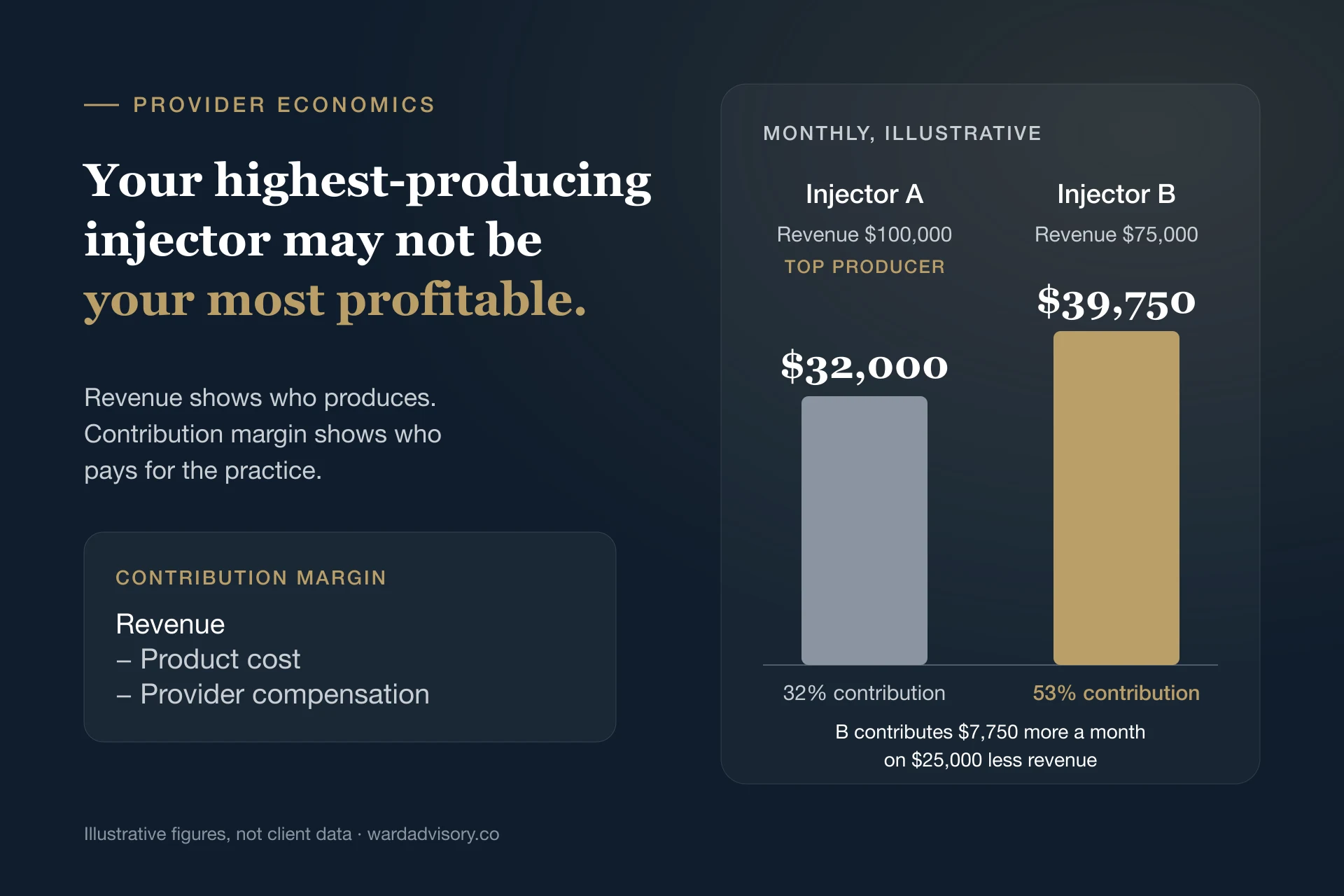
Injector A: $100,000 in revenue. Her product costs run 38 percent of her revenue, totaling $38,000. Premium fillers and higher waste raise the cost itself, and heavy discounting lowers what she collects per treatment, so the same product is a larger share of her revenue. Her compensation at 30 percent commission costs $30,000. Contribution margin equals $100,000 minus $38,000 minus $30,000, which is $32,000. Her margin percentage is 32 percent.

Injector B: $75,000 in revenue. Her product costs run 22 percent because of disciplined product selection, minimal discounting, and lower waste, totaling $16,500. Her compensation at 25 percent costs $18,750. Contribution margin equals $75,000 minus $16,500 minus $18,750, which is $39,750. Her margin percentage is 53 percent.
Injector B contributes $7,750 more to owner profit every month despite generating $25,000 less in revenue. The owner who only looks at the revenue report celebrates Injector A and overlooks the provider who is actually building wealth for the business.
Comparison Table: Side-by-Side Injector Profitability
| Metric | Injector A | Injector B |
|---|---|---|
| Revenue | $100,000 | $75,000 |
| Product Cost | $38,000 | $16,500 |
| Compensation | $30,000 | $18,750 |
| Contribution Margin | $32,000 | $39,750 |
| Margin % | 32% | 53% |
The table makes the point clearly. Injector B produces a 53 percent contribution margin on her revenue. Injector A produces 32 percent. That 21-point margin gap is the difference between an injector whose production funds the practice and one whose production mostly funds its own cost. Annualized, Injector B contributes $93,000 more to owner profit than Injector A: $7,750 per month that never shows up on the revenue report. Over five years, assuming performance remains consistent, that difference exceeds $450,000 of additional owner profit despite producing substantially less revenue. Margin percentage is the critical differentiator, not revenue volume. The owner who understands this runs a fundamentally different business than the owner who does not.
Most owners assume profitability is determined primarily by compensation percentage. In reality, compensation is only one variable. The most profitable injectors tend to outperform across several dimensions simultaneously.
Hidden Factors That Determine Injector Profitability
Compensation Structure
How you pay an injector directly shapes what kind of revenue they produce. Commission-only models incentivize volume above everything else. An injector earning a flat 30 percent on all services has no financial reason to care whether a treatment carries a 60 percent margin or a 40 percent margin. They earn the same either way. Hourly-plus-bonus structures can align better with profitability if the bonus thresholds are tied to contribution margin rather than gross revenue. Profit-sharing models reward contribution margin directly, creating natural alignment between injector behavior and owner outcomes. The most common mistake in compensation design is paying the same commission percentage on all services regardless of the margin differences between them. That single decision can cost an owner tens of thousands of dollars per injector per year.
Treatment Mix and Product Economics
Not all treatments are equally profitable, and the differences are larger than most owners realize. Measured on product cost alone, neurotoxin usually shows a higher margin than filler, because a syringe of filler costs far more relative to its price than the units in a typical toxin treatment. Treat any product-only margin as directional: neurotoxin in particular can be much thinner once provider time and overhead are loaded in. Device treatments such as microneedling, laser, and IPL carry low consumable costs per treatment, so their economics depend mostly on keeping the machine busy after the equipment is amortized. An injector who pushes filler over neurotoxin may generate higher revenue per appointment, but the practice keeps less of that revenue. Product waste and vial utilization rates also vary significantly between injectors. One provider may consistently get more billable units from a single vial than another, and that difference compounds across hundreds of treatments.

Discounting and Promotional Behavior
Some injectors habitually discount services to fill their schedules. They offer friends-and-family pricing, apply expired promotions, or extend membership discounts to patients who have not paid for memberships. Every discount reduces effective revenue per appointment without reducing the product cost of delivering the treatment. An injector who discounts 20 percent on a service with a 60 percent margin does not just reduce revenue by 20 percent. They reduce the contribution margin by a third or more. Membership discounts, when properly structured, can build loyalty and recurring revenue. But when injectors apply them loosely, they erode margin on every unit sold. An injector who maintains standard pricing at full schedule capacity is almost always more profitable than a discount-dependent injector running higher volume.
Retail Attachment and Ancillary Revenue
Retail product sales, including skincare, sunscreen, and post-procedure products, carry their own product margin. These sales generate incremental profit without requiring additional clinical hours. An injector who consistently recommends and sells retail products adds contribution margin that flows almost entirely to the bottom line after product cost. Retail attachment rates of 30 percent or higher significantly improve overall injector contribution margin. The same applies to rebooking rates and client retention. An injector who rebooks 80 percent of patients before they leave the treatment room creates predictable future revenue with zero additional acquisition cost. An injector who lets patients walk out without a next appointment scheduled is quietly reducing the lifetime value of every patient they treat. These behaviors do not show up on the monthly revenue report, but they show up in contribution margin over time.
Bad Compensation Plan Symptoms: Five Warning Signs
Symptom 1: Your Highest-Revenue Injector Has the Lowest Margin %
This is the classic revenue trap indicator, and it is more common than most owners want to admit. When the injector celebrated as the top producer consistently shows the worst margin performance, the compensation plan is rewarding the wrong behavior.
Symptom 2: Payroll Grows Faster Than Revenue
If compensation costs are increasing at a higher rate than production, the practice is slowly transferring wealth from owner to provider without realizing it. This often happens when commission percentages are set too high relative to treatment margins.
Symptom 3: Providers Push Low-Margin Services
Injectors naturally gravitate toward the treatments that maximize their own compensation. If the compensation plan does not differentiate between high-margin and low-margin services, injectors will optimize for volume and convenience, not profitability.
Symptom 4: Revenue Increases While Owner Income Stagnates
The business looks like it is growing. The top-line numbers are up. But the owner's take-home pay has not moved in two years. This is a sign that incremental revenue is being consumed by product costs and compensation rather than flowing through to profit.
Symptom 5: Your Top Producer Contributes Less Profit Than Others
The highest-paid injector is often the least valuable by the metric that matters most. The compensation plan has created a situation where the owner pays the most for the least return.
Why Compensation Design Matters: Rewarding Profit, Not Just Revenue
Poorly designed compensation plans incentivize injectors to maximize their own income at the expense of owner profitability. This is not a character flaw in the injectors. It is a predictable response to the incentives the owner created. If you're evaluating commission, salary, hybrid, or profit-sharing structures, read our complete guide to medical spa injector compensation structures before changing anything. When commission structures pay the same rate on all services, they ignore margin differences of 20 to 30 percent between treatment types. An injector earning 30 percent commission on a service with a 60 percent margin leaves the owner 30 percent. That is sustainable. The same 30 percent commission on a service with a 40 percent margin leaves the owner 10 percent. That is not sustainable after accounting for overhead, administrative costs, and the owner's own compensation.
Compensation should be tied to contribution margin, not gross revenue. When injectors are rewarded for generating profit rather than volume, their incentives align with the owner's. They begin to care about product costs, discounting discipline, and treatment mix because those factors affect their own earnings. Redesigning compensation around margin does not mean paying injectors less. It means paying them differently. It means paying more for high-margin production and less for low-margin production. It means structuring bonuses around contribution margin targets rather than revenue thresholds. The result is a compensation plan where what is good for the injector is also good for the owner.
The Four Metrics Every Owner Should Monitor
1. Contribution Margin per Injector
Contribution margin per injector is total revenue minus direct product costs and direct compensation costs. This is the single most important profitability metric for provider evaluation. It tells you exactly how many dollars each injector contributes to covering overhead and generating owner profit. Calculate it monthly and trend it over six to twelve months. A declining contribution margin is an early warning signal that something is changing in product costs, discounting behavior, or treatment mix, long before it shows up in the bank account.
2. Compensation-to-Revenue Ratio
The compensation-to-revenue ratio divides a provider's base pay, commissions, bonuses, and employer payroll taxes by that provider's net service revenue. Track benefits separately and use the same definition for each comparison. A higher ratio is a reason to examine treatment mix, pricing, paid hours, and contribution after product cost; it is not enough on its own to declare a provider unprofitable.
3. Revenue per Clinical Hour
Revenue per clinical hour measures efficiency, not just volume. An injector generating $1,200 per hour is more valuable than one generating $800 per hour at the same margin percentage. But this metric must be combined with margin analysis to give the full picture. High revenue per hour with low margins is not a win. The goal is high revenue per hour at high contribution margin. Track both together and watch for injectors who sacrifice margin to boost their hourly production numbers.
4. Retail Attachment Rate
Retail attachment rate is the percentage of clinical appointments that include a retail product sale. It is one of the easiest profitability metrics for an owner to track, and most point-of-sale systems report it automatically if retail is rung up separately. Retail adds contribution without adding clinical time, so even a modest improvement in attachment rate moves contribution margin. Compare attachment rates across injectors to see who is leaving incremental profit on the table and who is building it into every appointment.
Before You Redesign, Understand the Models
Before redesigning your compensation structure, understand the major injector compensation models used by successful med spas. The landscape includes hourly-only structures, hourly-plus-bonus arrangements, commission-only models, and profit-sharing frameworks. Each has different implications for injector behavior, owner profitability, and practice culture. The companion guide, Medical Spa Injector Compensation Structures: The 2026 CFO Guide, breaks down each model with financial examples and decision frameworks for selecting the right approach for your practice size, treatment mix, and growth stage.
Diagnostic Questions Every Owner Should Ask
Question 1: Which Injector Generates the Most Contribution Margin?
This month, this quarter, and this year: can you answer that immediately? If not, you are managing the business on incomplete information.
Question 2: Which Injector Has the Highest Compensation-to-Revenue Ratio?
That number tells you where your payroll dollars are going relative to production. An outlier here is often the first sign your compensation plan is misaligned with margin.
Question 3: Which Injector Creates the Most Owner Profit per Dollar of Compensation?
This is the efficiency ratio that matters most. It identifies the provider who gives you the best return on your compensation investment.
Question 4: Which Injector Would Hurt Profitability Most if They Left Tomorrow?
The answer may not be your highest-revenue producer. Losing a high-margin injector with strong retention and retail numbers can damage the business far more than losing a high-volume, low-margin provider.
Question 5: What Is the Margin Gap Between Your Top-Revenue and Top-Margin Injector?
If the difference exceeds ten percentage points, your compensation plan is almost certainly rewarding the wrong behavior.
Redesigning Compensation Around Profitability
Shifting from revenue-based to margin-based compensation starts with per-injector contribution margin for the past six months. That baseline tells you where the leaks are before you change anything.
The tiered approach is straightforward: pay higher commission on high-margin services and lower commission on low-margin services. An injector might earn 30 percent on neurotoxin and 20 percent on filler. The blended rate can stay competitive while protecting owner margin.
Consider an illustrative three-injector practice generating $240,000 in combined monthly injectable revenue on flat 30 percent commission across all services. Total compensation cost: $72,000, or 30 percent of revenue. After product costs averaging 28 percent ($67,200), contribution margin before overhead is $100,800.
Suppose the owner restructures to service-tiered rates: 30 percent on neurotoxin, 22 percent on filler, 18 percent on device treatments. Blended compensation drops to 26 percent of revenue, or $62,400 per month. Same production volume. Same patient count. No new marketing spend.
Compensation savings: $9,600 per month. Owner profit increases $6,000 per month after accounting for a modest performance bonus pool tied to contribution margin targets. Annualized, that is $72,000 in additional owner profit with zero revenue growth.
That is the point of margin-based compensation design. You are not asking injectors to produce less. You are stopping the plan from paying the same rate on every dollar regardless of what that dollar actually costs to generate.
The Most Valuable Injector Isn't Who You Think
Revenue attracts attention. Profit builds businesses.
The most valuable injector in your practice is not the one producing the most revenue. It is the one producing the most profit after compensation, product cost, discounting, and retention economics are accounted for. Most owners never calculate that number. The ones who do make better decisions, build stronger teams, and keep more of what they earn. If a specific provider's numbers look off, diagnose whether your compensation plan is the cause before assuming it is a performance problem.
For more on how provider pay plans are built, see the provider and capacity economics section of the library.
See this problem in your practice?
Ward Advisory can help work out how large the financial impact actually is and what's driving it.
Request a Strategy CallAbout the author
Tanner Ward
Founder of Ward Advisory. Tanner works with established med spas and aesthetic practices on where profit and cash are being lost and what to change, drawing on 10+ years of finance and operating experience.