Medical Spa Injector Compensation Structures: The 2026 Guide to Paying for Performance (Without Destroying Margins)
Stop losing margin to bad injector pay models. Learn four compensation structures and how to model sustainable provider pay using actual service economics.
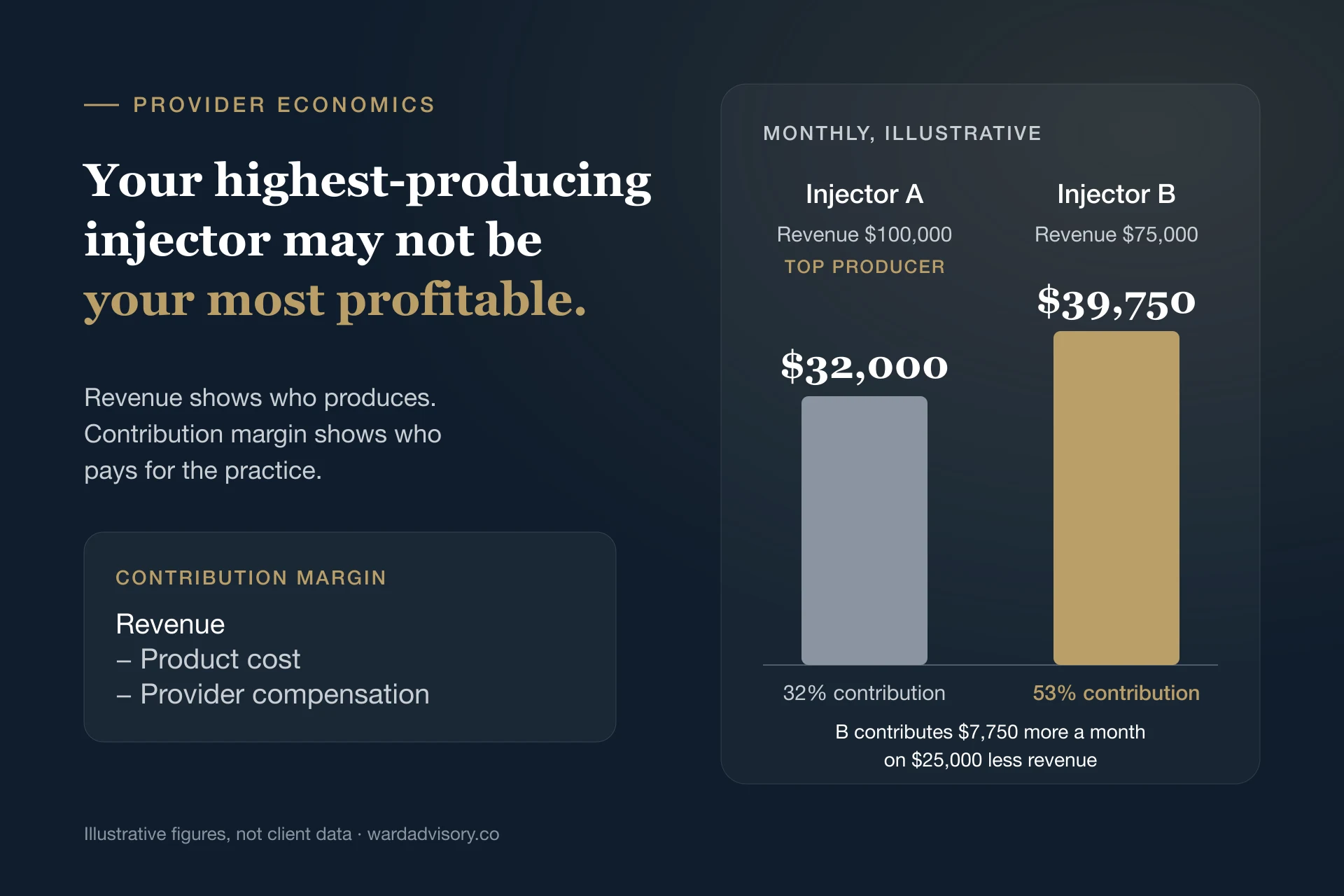
What this helps diagnose:Your compensation plan may be paying for revenue instead of profit.

You opened your med spa to build a business that rewards the risk you took. Yet every month, you look at your P&L and wonder why six figures in revenue leaves you with a personal paycheck that would embarrass a mid-level manager. You are not alone. The single biggest reason profitable-appearing medical spas hemorrhage cash is poorly designed medical spa injector compensation structures. Most owners inherit a model, copy a competitor, or agree to whatever a confident injector demands during the hiring conversation. The result is predictable: high production, thin margins, and an owner who works harder than anyone else in the building while taking home less than their top provider. This guide will change that. By the time you finish reading, you will understand exactly where your current pay model is leaking profit, what sustainable injector compensation ratios look like in 2026, and how to transition your team to a structure that rewards performance without sacrificing your bottom line.
Table of Contents
-
The Core Metric: Understanding Your Compensation-to-Revenue Ratio
-
The Four Most Common Compensation Models (and When They Work)
-
How to Transition Existing Injectors Without Losing Top Talent
-
Common Mistakes That Destroy Profitability (and How to Avoid Them)
Why Your Injector Pay Model Is Probably Bleeding You Dry
Walk through any med spa conference or Facebook group and you will hear the same advice repeated like gospel: pay your injectors 40 to 50 percent commission on everything they produce. It sounds simple. It sounds generous. It also sounds like a fast track to closing your doors.
The financial question is what remains after compensation, product, supplies, and overhead. Calculate those costs using actual treatment records and compensation terms rather than assumed industry percentages.
Consider an illustrative example. Your injector generates $10,000 in injectable revenue for the month. At a 45 percent commission rate, she takes home $4,500. Your product cost on that revenue sits at roughly $3,500, or 35 percent. Overhead allocation for that provider, including room time, scheduling, supplies, and marketing to fill her schedule, runs about $2,000, or 20 percent. Total costs: $4,500 plus $3,500 plus $2,000 equals $10,000. Your profit is zero. In months where product costs spike due to waste, or when the injector has a slow week and overhead remains fixed, you lose money. The pay plan, not the injector, is what makes the provider unprofitable.
This is the busy but broke syndrome. The spa feels successful because the schedule is full and revenue looks healthy on the top line. But the owner cannot take a meaningful salary. There is nothing left to reinvest in new devices, additional locations, or even a marketing budget that does not come out of personal savings. The injector is paid well for her production. The practice keeps nothing from it.
Calculate provider compensation using base pay, commissions, bonuses, and employer payroll taxes divided by that provider's net service revenue. Track benefits separately, then include them in the full profitability analysis. A ratio is not a verdict: product cost, paid capacity, and overhead determine whether the remaining contribution is adequate.
This is not about underpaying talent. It is about structural viability. A compensation model that produces zero margin cannot sustain raises, cannot fund training, cannot survive a slow quarter, and cannot deliver the owner a return on the risk and capital they invested to open the business in the first place. If your injector pay model leaves little or no profit on injectable services after product and overhead, the plan is not doing what a compensation plan is supposed to do.
The Core Metric: Understanding Your Compensation-to-Revenue Ratio
Before you can fix a problem, you have to measure it. The compensation-to-revenue ratio is the single most important number in med spa financial management, yet most owners have never calculated it. They track revenue. They track payroll. They rarely connect the two in a way that reveals whether their pay model is sustainable.
What Is a Healthy Ratio?
Start with the denominator: the net service revenue produced by the provider. Do not compare that ratio directly with total payroll divided by practice revenue. Use the same compensation definition across providers and periods.
Set a compensation budget from actual product cost, service time, overhead, and the return required to sustain the practice. Model low, expected, and high production before agreeing to rates.

Investigate an unexplained increase in the ratio alongside changes in service mix, realized prices, compensation terms, and utilization. Avoid diagnosing a structural loss from the ratio alone.
How to Calculate Your Current Ratio
Divide base pay, commissions, bonuses, and employer payroll taxes by net service revenue for the same period. Keep benefits separate for comparison, and add them back when calculating full delivery cost.
Here is an example. Your nurse injector produces $50,000 in injectable revenue for the month. Her base salary for the month is $6,000. She earns an additional $6,000 in commission. Her total compensation is $12,000. Divide $12,000 by $50,000 and you get 0.24, or 24 percent. This example excludes employer taxes and benefits; profitability still depends on other costs.
Now consider the same production with a different pay structure. The injector produces $50,000 but earns a flat 40 percent commission with no base. Total compensation is $20,000. The ratio is 40 percent. That is a disaster. The owner is losing money on every treatment, even if the bank account looks full mid-month.
Pull your last three months of profit and loss statements. Calculate the ratio for each injector individually. Do not average them together, because a high performer on a reasonable structure can mask a lower performer on an overly generous deal. Write down each ratio. If any number starts with a three or a four, you have found your profit leak.
Directional compensation ranges by tier (total compensation as a percentage of that injector's own service revenue)
The Four Most Common Compensation Models (and When They Work)
There is no single correct way to pay injectors. The right model depends on your practice volume, your provider mix, your service menu, and your growth stage. What matters is that you choose intentionally rather than defaulting to whatever the industry seems to be doing. Here are the four structures you will encounter, along with the real-world tradeoffs of each.
Straight Commission (The Industry Default)
Straight commission pays a defined percentage of collected service revenue. It is easy to explain, but the same rate can produce very different practice contribution across services. Model the rate against the actual service mix.
The appeal is obvious. Straight commission is easy to explain and easy to calculate. It strongly motivates production, because the injector's income is directly tied to every syringe and unit. For high-volume injectors who bring their own established clientele, this model can feel fair and entrepreneurial.
The downsides are severe. Straight commission at typical med spa rates destroys profitability on lower-margin services like neurotoxins. It encourages a treatment-mill mentality where volume trumps patient care, because the injector's only financial incentive is to do more, not to do better. It provides no income stability for the injector, which makes hiring harder and increases turnover risk during slow periods. It also makes it nearly impossible to enforce non-clinical responsibilities like charting, training junior staff, attending team meetings, or contributing to retail sales. The injector's rational response to any request that does not generate immediate commission is to resist it.
Straight commission works best in very specific circumstances: high-volume, low-overhead practices, or situations where the injector is a true independent contractor who brings their own patients, manages their own schedule, and operates with minimal support from the spa. For most W-2 employed injectors in a full-service med spa, straight commission is a margin killer.
Salary Plus Bonus (The Stability Model)
The salary plus bonus model provides a guaranteed base salary, typically in the range of $75,000 to $100,000 annually for a full-time injector, plus a bonus tied to hitting defined revenue thresholds. The bonus might be a flat dollar amount for achieving a monthly or quarterly target, or a percentage paid on revenue above a certain floor.
This model offers predictability for both parties. The owner knows the maximum payroll exposure and can budget accordingly. The injector has financial security, which reduces turnover and makes the practice more attractive to experienced providers who are tired of the feast-or-famine commission cycle. It also makes it easier to require and enforce non-clinical duties, because the base salary compensates the injector for being present and engaged, not just for producing.
The risk lies in bonus design. If the revenue threshold is set too low, the injector hits it easily and the effective compensation ratio climbs into dangerous territory. If the threshold is too high, the bonus becomes demotivating and the injector treats the job like a salaried position with no upside. The sweet spot requires careful modeling. A common rule of thumb is to set the bonus floor at roughly five times the injector's hourly rate equivalent. For an injector earning $80 per hour, the bonus would kick in after $400 in daily production, or approximately $8,000 per month. This ensures the spa covers its costs before sharing additional revenue.
Salary plus bonus works well for established med spas with a steady, predictable flow of new and returning patients. It is less effective in startup practices where revenue is highly variable and the owner needs to minimize fixed costs.
Tiered Commission (The Growth Incentive)
Tiered commission structures increase the commission rate as the injector hits progressively higher revenue milestones. A common structure might pay 15 percent on the first $30,000 of monthly production, 20 percent on production between $30,000 and $60,000, and 25 percent on production above $60,000. Some practices add a fourth tier for exceptional performers crossing $80,000 or $100,000 per month.
The tiered model solves one of the fundamental problems with flat commission: it avoids giving away margin on lower production levels while still rewarding high performers handsomely. The lower tiers protect the spa's profitability when an injector is building their book or having a slower month. The higher tiers incentivize growth without requiring the owner to renegotiate compensation every time an injector's production increases.
Tiered structures require accurate production records and timely reconciliation. Show providers how thresholds and rates work, and verify total cost across the full production range before adopting the plan.
This model is ideal for growing practices where the owner wants to incentivize injectors to actively build their books. It aligns incentives naturally: the injector who invests time in patient education, retail recommendations, and rebooking sees their income rise as their production grows, without the owner having to manage that process manually.
Hybrid Models (The Recommended Approach)
A hybrid model combines base pay with defined incentives and, where appropriate, a carefully specified profit-based component. Model each element across realistic production levels so the complete employer cost and provider pay are clear.
This is the model Ward Advisory recommends for most med spas in the $1 million to $10 million revenue range. The base salary provides stability and supports non-clinical responsibilities. The commission maintains a direct link between effort and income, keeping the injector motivated to produce. The profit-sharing component aligns the injector's interests with the overall health of the business, encouraging behaviors that benefit the practice beyond just personal production, such as mentoring junior staff, contributing to a positive team culture, and looking for operational efficiencies.
The hybrid model requires more upfront financial modeling than a simple commission structure. You need to project total compensation at various production levels and ensure the ratio stays within your target range. You also need to define profit-sharing triggers clearly, whether based on practice-wide net profit, departmental margin, or a combination of individual and team metrics.
Injectors accustomed to high commission rates may resist the transition to a hybrid model. This is a communication challenge, not a structural flaw. When presented correctly, with transparent numbers showing how the hybrid model can match or exceed their current income at reasonable production levels while providing base security they currently lack, most reasonable injectors will engage with the conversation. Those who refuse often reveal that they were over-earning relative to their production, which is exactly the problem you are trying to solve.
Comparison of injector compensation models
| Model | Best For | Main Advantage | Main Risk |
|---|---|---|---|
| Straight commission | High-volume producers or true contractors | Simple and production-driven | Can destroy margins quickly |
| Salary plus bonus | Established med spas with steady volume | Predictable payroll and better retention | Bonus floor must be modeled carefully |
| Tiered commission | Growing practices | Rewards production while protecting margins | Requires clean tracking and reporting |
| Hybrid model | Most $1M–$10M med spas | Balances stability, incentive, and profitability | Requires upfront modeling and clear communication |
Example Calculations: The Impact on Owner Income
Numbers in the abstract are easy to dismiss. Let us make them concrete with three illustrative scenarios. Each assumes the same product cost ratio of 30 percent and overhead allocation of 20 percent, round assumptions chosen to keep the comparison simple.
Scenario A is the overpayer. Your injector generates $60,000 in monthly injectable revenue. She is on a straight 40 percent commission model. Her paycheck is $24,000. Product costs consume $18,000. Overhead takes $12,000. Total costs are $54,000. The owner nets $6,000, a 10 percent margin. On an annualized basis, that is $72,000 in owner profit from a provider producing $720,000 in revenue. The injector earns $288,000. The owner, who bears all the risk, covers all the fixed costs, and built the practice, earns a quarter of what the injector takes home.
Scenario B is the optimized model. Same $60,000 in monthly revenue. The injector is on a hybrid structure: a base salary of $10,000 per month plus 15 percent commission on revenue above $40,000. She produces $60,000, so her commissionable revenue is $20,000. Her commission is $3,000. Total compensation is $13,000, a 21.7 percent ratio. Product costs are still $18,000. Overhead is still $12,000. Total costs are $43,000. The owner nets $17,000, a 28.3 percent margin. Annualized, the injector earns $156,000, a strong income by any standard. The owner earns $204,000 from that provider, plus has margin to reinvest in growth.
Scenario C is the high performer. Your senior injector generates $100,000 per month. She is on a tiered model: 20 percent on the first $80,000 of production and 25 percent on production above $80,000. Her commission on the first $80,000 is $16,000. Her commission on the remaining $20,000 is $5,000. Total compensation is $21,000, a 21 percent ratio. Product costs are $30,000. Overhead is $20,000. Total costs are $71,000. The owner nets $29,000, a 29 percent margin. The injector earns $252,000 annually. The owner earns $348,000 from that provider.
The difference between Scenario A and Scenario B is $132,000 in annual owner profit per injector. If you have three injectors on overly generous commission structures, you are leaving nearly $400,000 on the table every year. That is a second location. That is a down payment on a building. That is your children's college education. That is the difference between owning a job and owning a business.
Monthly economics by compensation scenario
| Scenario | Monthly Revenue | Injector Compensation | Product Cost | Overhead | Owner Profit | Owner Margin |
|---|---|---|---|---|---|---|
| Scenario A: 40% commission | $60,000 | $24,000 | $18,000 | $12,000 | $6,000 | 10.0% |
| Scenario B: hybrid model | $60,000 | $13,000 | $18,000 | $12,000 | $17,000 | 28.3% |
| Scenario C: senior tiered model | $100,000 | $21,000 | $30,000 | $20,000 | $29,000 | 29.0% |
How to Transition Existing Injectors Without Losing Top Talent
Changing compensation is the conversation most owners dread. You have a team that has grown comfortable with the current structure. You fear that any adjustment will send your top producer to the competitor down the street. That fear is valid, but it cannot paralyze you. A compensation model that destroys profitability is not sustainable, and delaying the fix only makes the eventual conversation harder.
The Communication Strategy
Frame the transition as an upgrade, not a pay cut. The new model offers something the old model does not: income stability. Straight commission injectors live with constant financial anxiety. A slow month, a vacation, an illness, and their income drops. The hybrid model provides a reliable base salary that covers their bills regardless of seasonal fluctuations. This is genuinely valuable, and most experienced injectors recognize it once it is presented clearly.
Be transparent about the business reality. You do not need to share every line item of your P&L, but you should share enough for the injector to understand the math. Explain that product costs consume roughly a third of every dollar they generate. Explain that rent, marketing, support staff, and insurance consume another quarter. Show them that at their current commission rate, the spa retains nothing, or loses money, on their production. Most injectors have never seen these numbers. They assume, reasonably but incorrectly, that if they are generating high revenue, the business must be highly profitable. Education alone often shifts the conversation from adversarial to collaborative.
Offer a transition period. A three to six-month window during which the injector can choose between the old and new models each month allows them to see which structure actually pays better. In most cases, the new model will match or exceed their previous income at normal production levels while providing base security. Letting them prove that to themselves is far more effective than trying to convince them with spreadsheets.
Structuring the New Offer
For your highest producers, those consistently generating $80,000 or more per month, consider a grandfather clause that protects their income during the transition. This might mean a slightly higher base salary for the first year, a guaranteed minimum total compensation for the first two quarters, or a profit-sharing override that gives them a small percentage of practice-wide profits above a certain threshold. The goal is to retain the talent while gradually moving them to a sustainable ratio. A senior injector producing $100,000 per month is worth protecting, even if the transition takes a few extra months.
Budget professional development and other benefits explicitly. A continuing-education stipend or paid conference attendance is an employer cost even when tracked separately from the payroll ratio. Cash bonuses also belong in compensation.
If a bonus includes operational measures, define each one precisely and set targets from the practice's own baseline. Rebooking at checkout, repeat-patient share, retail revenue share, and visits with a retail purchase are different measures. Include patient care and service quality when designing incentives.
What to Do If an Injector Leaves
Some injectors will leave rather than accept a new compensation structure, no matter how fairly it is presented. Do not panic. A departure is painful in the short term but often beneficial in the medium term. It creates an opening to hire at the correct ratio from day one, resetting the compensation expectation for that role permanently.
Protect yourself before the conversation happens. Ensure every injector has signed a non-solicitation agreement that prevents them from taking your patient list or recruiting your other staff if they depart. These agreements must be drafted by an attorney familiar with your state's laws, as enforceability varies significantly by jurisdiction.
Recruit with a financially modeled compensation structure and clear expectations. Test the proposal across realistic production levels before making an offer.
How to Model Compensation by Experience and Role
Experience and clinical responsibilities affect the offer, but sustainable compensation still depends on the services delivered and their costs. For each role:
- Forecast achievable service volume and realized prices.
- Deduct product, supplies, processing, and other variable delivery costs.
- Model base pay, incentive terms, employer taxes, and benefits at several production levels.
- Check whether the remaining contribution covers overhead and the intended return.
- Assess the proposal against local hiring conditions, clinical responsibilities, and qualified legal advice.
A junior provider's ramp-up and a senior provider's established book require different assumptions. Neither should be assigned a universal compensation percentage solely because of experience.
Common Mistakes That Destroy Profitability (and How to Avoid Them)
Even owners who understand the compensation-to-revenue ratio can sabotage their profitability through structural errors in how they calculate and administer pay. These five mistakes appear repeatedly in practices that look busy but generate disappointing owner income.
Mistake number one is paying commission on product cost. If your injector earns a percentage of the retail price of a syringe of filler, you are paying commission on money that went straight to Allergan or Galderma. The commission should be calculated on the margin after product cost, or the commission rate should be set low enough to account for the fact that a significant portion of the service price is pass-through cost. A 20 percent commission on the full service price is effectively a much higher percentage of the actual value the injector adds. Model this carefully.
Model non-injectable services separately. Device use, consumables, treatment time, and retail contribution differ by role, so each service needs its own cost model.
Mistake number three is the absence of a minimum revenue floor. Without a base threshold that the injector must cross before commission kicks in, you can lose money on slow days. The five-times-hourly-rate rule is a useful starting point. If an injector earns $75 per hour, the commission floor should be set at $375 in daily production. Below that level, the practice is covering base pay but not making margin. The commission structure should protect against paying bonus compensation on revenue that has not yet covered the injector's own base cost.
Mistake number four is treating all services identically. Neurotoxin and filler carry very different product costs relative to price, so their margins differ, and a single commission rate treats them as if they were the same. Body contouring and laser treatments have entirely different cost structures. A sophisticated compensation model differentiates commission rates by service category, paying a lower rate on low-margin services and a higher rate on high-margin services. This aligns the injector's incentives with the practice's profitability rather than encouraging them to gravitate toward the easiest or fastest treatment regardless of margin impact.
Mistake number five is forgetting compliance. The classification of injectors as W-2 employees versus 1099 independent contractors is not a matter of preference. It is governed by federal and state law, and misclassification carries significant financial penalties. Fee-splitting laws in some states prohibit certain types of commission arrangements. Anti-kickback regulations can be triggered by compensation structures that reward referrals. These issues vary by state and by the specific licensure of the injector. Consult a healthcare attorney familiar with your jurisdiction before finalizing any compensation structure.
Your Next Step
The right compensation structure is the single most powerful lever available to improve med spa profitability. It requires no capital investment, no new equipment, and no additional marketing spend. It does require looking honestly at the numbers, making the decision they point to, and having careful conversations with providers who have built their income around the current plan.
Most med spa owners never run the compensation-to-revenue calculation for their team. They sense something is wrong, feel the stress of tight margins, and work longer hours hoping volume will solve the problem. Volume without margin is just more work for the same disappointing result. The owners who build wealth in this industry are the ones who treat compensation design as a strategic function, not an administrative afterthought. If you want to check your own numbers against these models directly, get a diagnostic on your specific pay structure before deciding what to change.
For more on how provider economics fit together, including utilization and hiring, see the provider and capacity economics section of the library.
See this problem in your practice?
Ward Advisory can help work out how large the financial impact actually is and what's driving it.
Request a Strategy CallAbout the author
Tanner Ward
Founder of Ward Advisory. Tanner works with established med spas and aesthetic practices on where profit and cash are being lost and what to change, drawing on 10+ years of finance and operating experience.