Med Spa Payroll Percentage of Revenue: A Guide to Protecting Your Margins
Stop payroll creep from eating your margins. How to measure injector, esthetician, and admin payroll against the economics of your practice.
What this helps diagnose:Payroll keeps rising along with revenue and eating the growth.

If you are searching for the correct med spa payroll percentage of revenue, you already know that labor is your biggest controllable cost. You have likely felt the tension between staffing up to capture demand and watching your net profit shrink despite rising top-line numbers. That tension is not in your head. It is the central financial challenge of running a med spa in 2026, and most owners never get a straight answer on where their payroll should actually land.
Table of Contents
- Why Payroll Can Outrun Revenue
- The 2026 Med Spa Payroll Breakdown: Injectors, Estheticians, and Admin
- The Payroll Creep Trap: Three Signs Your Labor Costs Are Killing Margins
- How to Calculate Your Med Spa Payroll Percentage (Step-by-Step)
- Med Spa Payroll Percentage by State: Regional Benchmarks for 2026
- The Profit First Approach to Med Spa Payroll Management
- How to Fix a High Payroll Percentage (Without Firing Your Best People)
- Frequently Asked Questions About Med Spa Payroll Percentages
- Conclusion: Stop Guessing, Start Benchmarking
This guide breaks down the numbers for 2026. It is built specifically for med spa owners who want to catch payroll creep before it erodes a healthy net margin. By the time you finish reading, you will know how to measure what goes to your injectors, your estheticians, and your admin team, how to set a budget for each, and what to do if your numbers are off.
The examples below explain the arithmetic; they are not recommended industry ranges. Set payroll targets from your own service contribution, staffing needs, and overhead. Keep definitions consistent before comparing providers or periods.
Three Different Payroll Percentages
Most of the confusion about "the right payroll percentage" comes from mixing up three different measurements. Each has its own denominator:
| Metric | Numerator | Denominator |
|---|---|---|
| Total payroll | Staff base pay, commissions, bonuses, employer payroll taxes | Total net practice revenue |
| Provider compensation | One provider's base pay, commissions, bonuses, employer payroll taxes | That provider's net service revenue |
| Administrative payroll | Non-producing staff pay and employer payroll taxes | Total net practice revenue |
Benefits and contractor costs must be reconciled separately when they are not included in these definitions.
Keep these separate. A provider at 28 percent of her own production and a practice at 42 percent total payroll can both be perfectly reasonable at the same time.
Why Payroll Can Outrun Revenue
Revenue in the med spa industry keeps climbing, and that makes the industry look unstoppable. But rising revenue does not automatically mean rising profit. Many owners are working harder than ever and taking home less.
The culprit is usually payroll. Payroll is a mixed cost. Commissions and production bonuses move with revenue, but salaries and scheduled hourly wages behave like fixed costs: they are owed whether the schedule is full or not. And the fixed part tends to ratchet upward in ways that are hard to notice month to month. A new front desk hire here. An overtime shift there. A commission structure that was competitive three years ago but now eats into margins as service prices have plateaued. None of these decisions feels catastrophic in the moment. Together, they quietly push net profit below where it needs to be.
Payroll is only one part of the cost stack. The illustration below holds all other costs constant to show how changing payroll changes profit. It does not establish a universal payroll limit.
Illustrative example
Suppose everything except payroll costs 48 percent of revenue: COGS at 25 percent, occupancy at 10 percent, marketing at 6 percent, and software, fees, insurance, and supplies at 7 percent. Net profit is then whatever payroll leaves:
| Total Payroll % | Net Profit % |
|---|---|
| 35% | 17% |
| 40% | 12% |
| 45% | 7% |
| 50% | 2% |
In this illustration, increasing payroll by one point reduces profit by one point because all other costs are held constant. A different cost stack produces a different affordable payroll budget.

Payroll creep is the term for what happens when labor costs rise without a corresponding jump in revenue. It is slow. It is subtle. It does not announce itself with a single bad month. It accumulates through small decisions: keeping an underperforming provider on staff too long, adding administrative roles before patient volume justifies them, or letting overtime become the default rather than the exception. By the time an owner notices, the practice has lost tens of thousands of dollars in profit that cannot be recovered. Most owners do not know their real payroll percentage until someone calculates it properly, which is what the step-by-step section below covers.
The 2026 Med Spa Payroll Breakdown: Injectors, Estheticians, and Admin
Injectors (NPs, PAs, RNs): Measure Against Their Own Production
Injectors are the economic engine of most med spas. Neurotoxin, dermal fillers, and other injectable treatments generate the highest revenue per hour of any service category. They also command the highest labor costs.
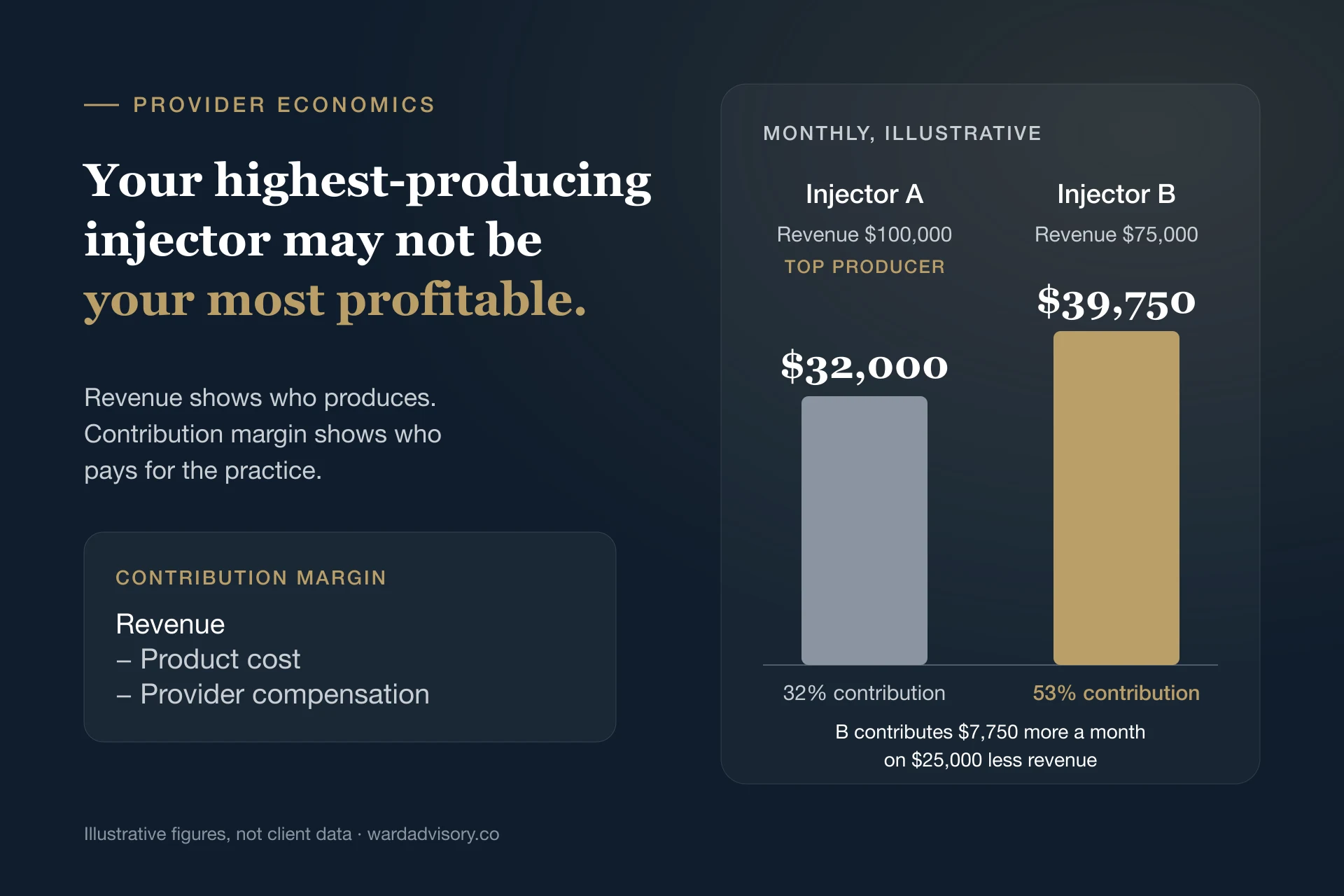
Measure injector compensation against that injector's net service revenue. Include base pay, commissions, bonuses, and employer payroll taxes; track benefits separately. Compare the resulting contribution after product cost with the overhead and profit the service line needs to fund.
Skilled providers should be paid for the value they create. Assess compensation alongside service contribution, patient care, and capacity rather than using a single ratio as a verdict.
Commission is the most common pay model for injectors, and it directly determines where the ratio lands.
Illustrative example
A structure that pays 30 percent commission on service revenue and 20 percent on retail sales: an injector generating $40,000 in monthly service revenue earns $12,000 in commission, exactly 30 percent. If she also sells $5,000 of retail, the additional $1,000 brings her total to $13,000 on $45,000 of combined revenue, about 29 percent. This example excludes employer payroll taxes and benefits, which must also be budgeted.
At 40 percent commission, which some practices offer to attract talent in competitive markets, the same $40,000 producer costs $16,000, or 40 percent of her service revenue, before payroll taxes and benefits. The practice has 60 percent left to cover product, rent, admin, marketing, and profit. On injectables, where product alone can take 30 to 45 percent of revenue, that leaves very little.
Provider utilization helps explain whether paid clinical capacity is being used. Measure completed treatment hours against paid hours available for treatment, excluding paid time off. Before hiring, check sustained demand, appointment availability, treatment quality, administrative time, and the cost of capacity that is already unused.
Estheticians: Include the Full Cost of Delivery

Esthetic services have different combinations of provider time, product, room, and device costs. Build their compensation budget from contribution by service and the hours required to deliver it.
Evaluate retail contribution separately from treatment contribution. Include product cost and any retail incentive before crediting retail sales to a provider's economics.
Estheticians may also introduce patients to other appropriate services. Measure that contribution using actual referrals and follow-up rather than assuming future revenue will offset a current loss.
Admin and Front Desk: Budget Against Workload
Administrative payroll is where many med spas leak profit. Front desk staff, office managers, billing coordinators, and marketing personnel are essential, but they do not generate revenue directly. Every dollar spent on admin has to be covered by the margin on services provided by injectors and estheticians.
Budget administrative payroll against the work required to serve current demand. Include wages and employer taxes, with benefits shown separately so the payroll ratio matches the metric definition.
For the practice manager specifically, skip percentage-of-payroll rules and work from the admin budget.
Illustrative example
In that $2 million practice, admin payroll at 12 percent is $240,000. If a practice manager costs $90,000 fully loaded, that is about 38 percent of the admin budget, leaving $150,000 for front desk and coordinator roles. If one manager's fully loaded cost is consuming more than half of the admin budget, either the rest of the front office is thin or the role is priced above what the practice can support.
Evaluate automation against the cost and quality of the work it replaces. Online scheduling reduces the need for full-time phone coverage. Automated billing and payment processing cut the hours spent chasing payments. Patient relationship software handles follow-up communications that would otherwise take staff time. Each tool carries a subscription cost, but that cost is a fraction of what an additional full-time employee adds to payroll.
Set the Total Payroll Budget From the Cost Model
Provider ratios use each provider's service revenue; administrative payroll uses total practice revenue. Add the dollar costs first and divide by total net revenue to calculate a blended practice ratio. Do not add percentages with different denominators.
Review the payroll budget each month against actual demand, service contribution, and forecast cash. A variance should prompt investigation of hours, rates, mix, and pricing before a staffing decision.
The Payroll Creep Trap: Three Signs Your Labor Costs Are Killing Margins
Payroll creep does not announce itself with a single bad decision. It accumulates through patterns that feel reasonable in isolation but add up to margin erosion. Here are the three most common signs that creep is already happening in your practice.
The first sign is utilization declining against the practice's own history while paid hours stay unchanged. Look at cancellations, booking gaps, and treatment duration before deciding whether the issue is staffing or demand.
The second sign is overtime becoming the norm rather than the exception. Occasional overtime during a product launch or holiday rush is manageable. Overtime that consistently exceeds about 5 percent of total payroll signals a structural problem. It usually means you are understaffed in a way that forces existing employees to work extra hours at time-and-a-half. That premium pushes your payroll percentage higher than it would be if you hired an additional person at straight time. The fix is counterintuitive: hiring one more person can reduce total payroll percentage if it eliminates chronic overtime.
The third sign is administrative costs growing faster than the workload they support. Compare changes in staff hours, patient volume, collections, and service quality to understand what the additional cost is buying.
There is a hidden cost to payroll problems that most owners overlook: turnover. When checks are late, pay is calculated wrong, or workers are misclassified, employees lose trust and start looking elsewhere. Replacing a skilled injector costs far more than a recruiting fee. It means lost revenue during the search, reduced schedule capacity, and the risk of clients following the departing provider to a competitor. Every payroll error that triggers a resignation is a direct hit to your margins, and it is preventable.
How to Calculate Your Med Spa Payroll Percentage (Step-by-Step)
Most med spa owners think they know their payroll percentage. Many of them are wrong. They look at base wages and forget payroll taxes. They remember commissions but overlook benefits. They exclude contractor payments because those checks go to a different line item. The result is a number that looks healthier than reality.
Here is the correct calculation. Step one: total every dollar of labor cost. Include W-2 wages for all employees, 1099 payments to independent contractors, cash bonuses, commission checks, employer-side payroll taxes, health insurance premiums, 401(k) matching contributions, workers' compensation insurance, and any other benefit that costs the practice money. If you offer a uniform allowance or continuing education stipend, include it. This is your total labor cost.
Step two: determine your total revenue. Use trailing twelve-month revenue to smooth out seasonal swings. A single month can mislead. December might be slow. May might spike with pre-summer injectable demand. The twelve-month figure gives you a reliable baseline.
Step three: apply the formula. Divide total labor cost by total revenue and multiply by 100. That is your payroll percentage.
Illustrative example
For illustration, $720,000 of annual payroll divided by $1.8 million of net revenue is 40 percent. If payroll rises to $810,000 at the same revenue, the ratio becomes 45 percent. The $90,000 increase must be funded by lower other costs or lower profit.
Every percentage point of payroll creep on $1.8 million in revenue costs $18,000 in net profit. A practice that drifts from 40 percent to 45 percent over two years has lost $90,000 a year in profit, often without the owner noticing. That money could have funded a renovation, a new device, or a real increase in owner compensation.
Med Spa Payroll Percentage by State: Regional Benchmarks for 2026
Geography shapes payroll percentages in ways that a single national range cannot capture. Cost of living, state and local minimum wage laws, and local competition for skilled injectors all affect what you pay for labor. A practice in Dallas at 38 percent total payroll might be perfectly sound. The same percentage in Los Angeles could signal under-investment in staff that will lead to turnover.
California and New York sit at the high end. Both have statewide minimum wages well above the federal level, and many cities set their own higher local minimums, which pushes up the cost of front desk and support roles in particular. California also has a separate health care worker minimum wage law (SB 525) that sets higher, phased-in minimums for covered health care facilities. Whether it applies to a particular med spa depends on how the practice is licensed and organized, so confirm coverage with employment counsel rather than assuming either way. Add strict overtime rules and a competitive market for injectors, and practices in these states usually carry a higher payroll percentage for the same service mix. They have to offset it with higher pricing or leaner admin structures to stay under the ceiling.
Texas and Florida sit at the other end. Lower living costs and state minimum wages closer to the federal floor generally let practices run leaner on support payroll. Owners in these markets often expect to operate below the national middle, and that expectation is usually reasonable. Competition for experienced injectors is intensifying even in lower-cost states, though, so provider pay does not always follow the same discount.
Most Midwest and Mountain markets fall in between. Fast-growing metros with many new med spa openings tend to see provider pay rise as practices compete for the same pool of experienced injectors.
Use local hiring costs and the practice's actual prices when building the staffing budget. Geography changes the inputs; it does not provide a universal payroll target.
The Profit First Approach to Med Spa Payroll Management
Traditional accounting treats profit as whatever is left after expenses. That is dangerous in a med spa, because payroll has a way of expanding to consume whatever revenue is available. Profit First, the cash management method Mike Michalowicz lays out in his book of the same name, flips the sequence: you set aside profit first, then run the business on what remains.
Applied to a med spa, the allocation might look like this.
Illustrative example
| Allocation | % of Revenue |
|---|---|
| Profit, set aside first | 10% |
| Total payroll | 40% |
| COGS | 25% |
| Occupancy | 8% |
| Marketing | 5% |
| Everything else (software, fees, insurance, supplies, maintenance, education) | 12% |
| Total | 100% |
The discipline comes from the order. The profit transfer happens before any bills are paid, into a separate account. If the remaining 90 percent does not cover expenses, you adjust expenses, not profit.
The same table shows why payroll percentage matters so much. There is no slack in it. If payroll drifts from 40 to 45 percent, those 5 points have to come from somewhere, and in practice they come out of profit. At 50 percent, payroll consumes the entire profit allocation. When the numbers stop fitting, Profit First makes the problem visible immediately: you cannot hide behind the hope that next month will be better. You reduce labor cost, raise prices, or both.
If injector pay looks out of line, diagnose the compensation structure before assuming the whole team needs a pay cut.
How to Fix a High Payroll Percentage (Without Firing Your Best People)
Discovering that your payroll percentage is too high can trigger panic. The instinct is often to cut staff, but that risks losing the providers who generate your revenue. There are better ways to bring payroll back in line.
The first and often most effective strategy is to raise prices. Higher revenue with the same labor cost means a lower percentage.
Illustrative example
Say injectables are 60 percent of revenue and total payroll is 40 percent. A 10 percent injectable price increase with volume holding steady lifts total revenue about 6 percent. Salaries and hourly wages don't change, so if payroll dollars stayed flat, the percentage would fall from 40 to about 37.7. Commission paid on the higher prices gives back part of that, so the real improvement is usually one to two points.
Many med spa owners underprice relative to their market, especially if they have not raised prices in two or more years. Your injectors' skills have improved. Their client demand has grown. Your prices should reflect that.
The second strategy is to shift your service mix toward treatments with stronger margins after both product cost and labor. Revenue per hour matters, but so does what that hour costs: neurotoxin and filler bring in more per hour than facials or laser hair removal, and they also carry much more product cost. Analyze which services produce the best margin after product and provider pay, actively promote those, and consider limiting or repricing the weakest ones.
The third strategy is to restructure commission plans so the practice covers its costs before commission starts. A flat 40 percent commission might have made sense when you were building a client base, but it becomes hard to sustain as revenue grows. Two changes usually do more than cutting the headline rate. First, add a production floor: a base or hourly wage, with commission paid only on production above a threshold that covers the provider's base pay and share of fixed costs. Second, differentiate rates by service, paying less on product-heavy services and more on services with lower product cost. Be careful with escalating tiers that raise the rate as production grows: they pay the most on the highest-volume dollars, which still carry full product cost. If you use them, model the blended rate at realistic production levels and confirm it stays inside the 20 to 30 percent range. Before changing anyone's plan, read our injector compensation structures guide, and model what each provider would have earned under the new plan on their actual recent production so the change does not come as a surprise.
The fourth strategy is to review administrative workload and tools. Compare the cost and service quality of scheduling, billing, and patient follow-up before changing staffing. Automation should be evaluated on its actual cost and effect.
Before adding a provider, model demand, current capacity, lead time to hire, and the cash cost of ramp-up. Investigate an underperforming service line using actual contribution and capacity rather than a fixed utilization cutoff.
For more on provider pay, utilization, and profitability, see the provider economics topic hub. For how payroll fits into the rest of the income statement, see our line-by-line P&L breakdown.
Frequently Asked Questions About Med Spa Payroll Percentages
How should multi-location practices evaluate payroll?
Multi-location operations may share administrative costs but also add management and coordination costs. Measure each location and the consolidated business on the same basis, then set budgets that reflect both.
Should I include owner salary in the payroll percentage?
It depends on the owner's role. If the owner works in the business, treating patients or actively managing operations, include a market-rate salary for that work in the payroll calculation, even if you currently pay yourself through draws. That labor is part of what it costs to run the practice. If the owner is purely an investor who does not work in the business day to day, exclude their distributions. Those come from profit, not from the operating payroll budget.
What if my injectors are 1099 contractors?
Keep compensation and revenue definitions consistent across providers, and show contractor costs separately where accounting classification differs. Employment classification is a separate question for qualified employment counsel; a target ratio does not determine legal status.
How does seasonality affect payroll percentage?
Slower months can make payroll percentage spike even if total labor costs have not changed. A practice with $150,000 in monthly labor costs and $400,000 in typical monthly revenue has a 37.5 percent payroll percentage. If revenue drops to $320,000 in a slow month, that same labor cost is 46.9 percent. Do not panic over a single month. Use a twelve-month rolling figure to judge your true payroll percentage. Instead of cutting staff seasonally, reduce hours during slow periods or encourage providers to take paid time off.
What is a realistic payroll percentage for a brand new med spa?
A startup needs a funded ramp-up plan. Model payroll alongside patient acquisition, capacity, and cash runway, then compare results with that plan each month.
Conclusion: Stop Guessing, Start Benchmarking
Measure each payroll number against the right denominator. Set budgets using service contribution, required capacity, overhead, and owner compensation. Review the causes of changes rather than treating a national percentage as a verdict.
Payroll changes need context. Reconcile the ratio, investigate the cause, and assess any staffing or compensation change against patient care, contribution, and cash.
Payroll is one number inside a larger system. See how it fits with cash flow, COGS, and the other levers in the med spa financial operating system.
See this problem in your practice?
Ward Advisory can help work out how large the financial impact actually is and what's driving it.
Request a Strategy CallAbout the author
Tanner Ward
Founder of Ward Advisory. Tanner works with established med spas and aesthetic practices on where profit and cash are being lost and what to change, drawing on 10+ years of finance and operating experience.